The case for a marriage plebiscite

Could a public vote on same-sex marriage actually be beneficial to the cause? Simon Copland
thinks so.

DUBLIN, IRELAND - MAY 23:   A gay couple kiss in Dublin Castle Square as the result of the referendum is relayed on May 23, 2015 in Dublin, Ireland. Voters in the Republic of Ireland were taking part in a referendum on legalising same-sex marriage on Friday. The referendum was held 22 years after Ireland decriminalised homosexuality with more than 3.2m people being asked whether they want to amend the country's constitution to allow gay and lesbian couples to marry. Ireland voted overwhelmingly to legalise same-sex marriage in a historic referendum. More than 62% voted in favour of amending the country's constitution to allow gay and lesbian couples to marry. It is the first country in the world to legalise same-sex marriage through a popular vote. (Photo by Charles McQuillan/Getty Images)

The legitimacy of the proposed marriage equality plebiscite has again been called into question after government MPs Eric Abetz, Cory Bernardi and Bridget McKenzie declared they would not vote for same-sex marriage regardless of a public vote.

For many this highlighted the futility of the plebisicte, reinforcing the belief that it will be a waste of time, money and energy. In an email to supporters, Australian Marriage Equality wrote:

“If Eric and Cory are going to vote “no” regardless of the results of an extremely costly plebiscite, and couples are continuing to marry anyway, what’s the hold up? It’s well past time to end marriage discrimination, and our government has the ability to do that now.”

We’ve heard the arguments against a plebiscite many times. People point out that it’s not needed, that it would be expensive and that, given it wont be binding, it would not necessarily result in change. More seriously, some are concerned it will lead to vicious anti-gay attacks, leaving many queer kids vulnerable. Others are insulted at the idea of the general public voting on ‘our rights’, saying it’s not up to the general population to decide these issues. I understand these concerns, but I believe a plebiscite would still be worth it. In fact, it is one of the best ways we can tackle anti-gay oppression.

Let’s start by looking at the most serious points against a public vote. Many are rightfully worried a vote will result in hideous attacks from opponents of LGBTI rights which could leave same-sex attracted youth in a vulnerable position. This is a genuine concern and one I share. But I ask whether a plebiscite is actually the catalyst for such a thing? Just last week for example stickers with the slogan ‘cure AIDS — kick a poofter to death’ appeared across Melbourne. Anti-gay attacks are occurring well outside a vote.

These sorts of events have been going on for years. They are the expected outcome from a growing movement that challenges the social order. Yet, they do not stop us. Instead they make us speak out, get stronger and build our movement. We don’t shy away from the homophobia, instead fighting it head on. Why would this be any different during a public vote?

This connects to the irk many feel at the idea of the public voting on ‘our rights’. I’ve always found this confusing. Why do we see a parliamentary vote so differently than a public vote? Aren’t politicians supposed to be a reflection of the general public? Aren’t we therefore already voting on same-sex marriage every three years, just through the proxy of national elections?

I think handing our rights over to politicians is actually far more insulting. Politicians have had countless opportunities to vote on this issue and have failed time and time again. This has occurred while the community is marching forward, now supporting marriage equality by a wide margin.

For some reason we keep placing our faith in our elected leaders — putting our lives into the hands of politicians who have proven themselves to be far more apprehensive than the general public. I think it’s time we change that — taking power away from them and give it to those who actually support us.

It is in giving this power to the public I think we have the opportunity to create change that goes well beyond marriage.

Over recent years the same-sex marriage movement in Australia has focused its energy on lobbying politicians. Just last year Australian Marriage Equality released its ‘new’ strategy, focusing its energies on shifting the eight votes needed to pass a bill in Parliament. These strategies continue to fail, largely because our focus sits in the wrong place. Instead of focusing on backroom lobbying we should be looking to our local communities.

This is the potential power of a plebiscite. A plebiscite puts marriage onto the national agenda and makes it one we have to deal with street-by-street. It means we can put our energy into championing queer campaigners and allies in local communities, empowering people to be local advocates for change. It means we can organise to tackle homophobia and transphobia as it exists at a local level — whether it is young kids facing discrimination in schools or trans people facing the threat of violence on the streets.

Most importantly it means that we can embarrass the government by showing them that our community does support our rights — and it does so with a huge margin. This will cut short the attacks of those such as Abetz and Bernardi, which will be quite important as we move forward with our agenda. I understand people’s concerns about the anti-gay hate that may come, but change is difficult and often painful.

When she finally changed her mind on same-sex marriage, Julia Gillard came out swinging against a public vote, saying the “only foundation stone for the idea of a plebiscite or referendum is an appeal to the all-too-popular sentiment that politicians are inadequate, that their decision-making is somehow deficient”.

This is exactly the point. Our politicians are inadequate. They have failed and they continue to do so. It’s time to take the decision out of their hands and make it ours. The benefits will be huge.

The Sydney Festival of Really Good Sex

Over the weekend I went to Sydney with my partners James and Martyn for The Sydney Festival of Really Good Sex. I went to this festival for the first time last year, writing a review for the Guardian. This year I went as a presenter — hosting the workshop (with James and Martyn) ‘how the manage a non-traditional relationship’.

IMG_3664

This was the first time I’ve ever done this workshop and I wanted to do some short reflections. The workshop ran in the following way: 

  1. We gave some brief introductions, outlining the aims and telling our story of living in a non-traditional relationship.
  2. We discussed as a big group what a non-traditional relationship is, working to expand it beyond narrow definitions which are often largely focused on polyamory or open relationships.
  3. We split people into small ‘home groups’. Within these groups people introduced themselves and answered questions about what excited them about non-traditional relationships, and what made them nervous.
  4. We then split people up again into bigger ‘discussion groups’. People could decide whichever group they wanted to go to, answering one question per group about non-traditional relationships. Topics included jealousy and anxiety, managing logistics and time, writing relationship agreements, coming out to family and friends and having and looking after children.
  5. Finally, we brought people back into their ‘home groups’ in order to share their learnings. Ideally each home group would have had one person in each discussion group, meaning people would be able to hear and reflect on the main points from each group.

Doing this for the first time ever I was quite nervous but we had some pretty amazing feedback. We ran the session two times (one on Saturday and one on Sunday) and had a number of people return for a second time. In particular I think the following things worked pretty well.

First, we worked actively to make an open space that allowed for a broad definition of a ‘non-traditional relationship’, in turn giving everyone space to feel comfortable within the group. I think this is important given the depth of relationship models in our society, ones you often can’t put labels on. These relationships need to be recognised as well and we didn’t want to limit experiences to just polyamory or open relationships. 

Secondly, the ‘home group’ model gave people a safer space to discuss their questions/concerns, rather than putting them in front of a large group (our first session had 45 people in it!). Over the session people could get to know those in their home group, giving them a safer space to discuss the questions presented.

Finally, we made the section for our ‘discussion groups’ quite long (1/2 hour), which I think was great. What this meant was that instead of everyone getting a small bit of information (if we had tried to get them to answer all the questions) people got an in depth view of one issue. They could then take this in depth view to their friends and colleagues, sharing with their home group and with others after the workshop.

Overall this session was designed to be one that focused on the idea of group knowledge. We didn’t want to present ourselves as the ‘experts’ — ones who would stand up and deliver all the answers. We simply don’t have those answers! So instead we were able to use the knowledge and power of the room to get the solutions and answers out. This was really great for us too — we sat in on the discussion sections, I think each of us learning a great deal as we did.

It was a great session and I really really enjoyed running it.

I am now also making it available to anyone who wants a session themselves. If you’re interested in the session please email me at simon_copland@hotmail.com I am in the process of working out fees and charges and will soon have details available on the site. But in the meantime get in touch and we can talk.

Queers — Episode 3 — Queering Bowie

We’re back! And this time for real.

After some false starts last year last week Benjamin Riley and myself got going (again) on our new podcast — queers. Following the awful news of his death earlier in the year, we had to start the year by talking about all things David Bowie.

bowie-glam-rock-6-Matador-SEO

You can check out episode three in the link below or follow the feed on Podomatic. The new episode is available here.

Enjoy!

Could Bowie be Bowie today?

It’s just over a week now since David Bowie died and the reaction to his death, and his legacy, is ongoing.

Naturally one of the biggest discussions has been the impact Bowie has had on sexual politics and our ideas of sexuality, gender and identity. This was actually something I wrote about just days before his death. Bowie was a chameleon, living a life of fluid sexuality, gender and identity.

david-bowie-40-anni-di-ziggy-stardust-l-alieno-sessualmente-ambiguo_h_partb

Yesterday I recorded a podcast (to be uploaded soon) about Bowie and his sexual legacy. A big part of our discussion was about the fluid nature of Bowie’s sexual identity, something which lead me to ask the question, could Bowie be Bowie today?

This question came to my mind after my fellow podcaster Ben asked me — how would Bowie have identified himself sexually? The answer is not simple.

Bowie first ‘came out’ as gay in 1972, just before the release of Ziggy Stardust. He did so whilst married to his first wife, Angie. His ‘coming out’ however did not seem to affect his marriage and in fact they stayed together until 1980. Over time this label of ‘gay’ changed and soon Bowie spoke more about himself as being bisexual. Ziggy Stardust, who I reckon was a strong reflection of how Bowie saw himself at the time, was identified as ‘bisexual rock superstar’.

But this changed as well. As Bowie got older he seemed to drop the bisexual label, whilst at the same time not denying his sexual past. In an interview later in his life Bowie  was asked “you were gay for a while?” to which he responded “I was just happy… I got me leg over a lot.” Bowie goes on to talk about his promiscuous ways and how that promiscuity extended to people of all different genders.

It is this fluid identification that really defines Bowie as an artist, performer and human being. It is his lasting legacy on sexual politics. Yet at the same time it is reasonable to think there is no way he would have gotten away with similar shifts if he were performing today.

Since the sexual revolution of the 1970s, in which Bowie played a major part, our perceptions of gender and sexual identification have become deeply essentialised.

When it comes to sexuality this has been framed largely through the lens of the ‘gay gene’ and the idea that we’re all ‘born this way’. Sexual identity has become fixed — you are born into one and any variation is an abnormality. Even within chunks of the gay community bisexuality is still seen as a ‘phase’ someone goes through until they decide on their real sexual identity. If people divert from our understandings of sexual identity (i.e. straight identified dudes having sex with men) then you are quickly ridiculed and told to ‘just admit’ that you are gay. Even worse if you dare suggest that your sexuality can be fluid you are quick to be chastised. Probably the most famous example of this being the reaction to Cynthia Nixon and her declaration that she chose to be a lesbian. Nixon was told by many that her statement was hurting the cause of gay rights and in turn forced to backtrack.

The same can be said about gender. As trans* issues, rightfully, enter the mainstream, discussion of gender is becoming essentialised. Instead of being a social construction, gender is framed as an essential part of one’s being, with gender becoming increasingly naturalised in what can be seen as a very conservative way.

Altogether this is creating a culture, particularly within queer communities, that I’m not sure Bowie would have survived in. With a growing essentialisation of gender and sexuality, it is easily possible that Bowie would have been seen as ‘playing’ with gender and sexuality, something I think many would consider to be mocking gays, lesbians, bisexuals and trans* folks. We can see this play out with those who don’t fit these essentialised norms, whether it is some of the reaction to Brooke Hemphill’s “Lesbian for a year” (which did genuinely have a lot of problems) or the controversy over the banning of drag queens at a pride event in Scotland last year. In both of these examples those who didn’t fit the essentialised notion of gender or sexuality were attacked by other queers for daring to do so.

This leads me to ask a number of questions. Would we, for example, accept a man who comes out as gay while remaining married in today’s culture? Or would we tell him that his identity is wrong and that he’s using our sexual identifier as a way to boost his career, at the expense of our community?  Would the idea that Bowie was performing differing genders, as he often did throughout his career, be seen as insulting to the trans* community? Would we let someone get away with such open promiscuity without criticising him for hurting the political chances of other gays and lesbians?

I ask these questions as I think they could say a lot about the impact of essentialising sexuality and gender identification. These questions highlight to me where we’ve come as a movement and a community, and in ways that deeply concern me. Bowie was clearly not perfect but he had such a deep impact on the ways in which we think about gender, sexuality and identity. He shaped much of our modern thinking, and for the better.

It concerns me deeply that we would likely attack anyone who tried to do the same. And that their influence could be lost.

What David Bowie means to me

I first heard the news in the car on the way to the gym. At the time it was not official, just rumours. By the time we got inside it was real. David Bowie is dead.

My partner and I spent a few minutes getting ready but then I just stopped. In the middle of the gym I burst into tears.

He is my hero. And now he is gone.

david_bowie_hd_wallpaper-1600x1200

***

I first discovered David Bowie when I was an eager teenager exploring the world of music. Talking to my mum one day she pulled out the one album of his she owned — his best of from 1969 – 1974. I’d never heard of him but was willing to give it a try.

The next day, studying at school, I put my headphones on, put the CD into my discman, and gave it a whirl.

I was immediately transfixed. The music was unique. The lyrics inspiring. His voice mesmerising. I loved every song.

It’s no coincidence Bowie hit me at a time I was struggling. As a confused gay teenager I went through bouts of depression in high school and suddenly here was someone who could speak to me. I didn’t really know about his gender-bending queerness at the time (I was just learning), but I knew somehow that he got it. He gave me a world where I could escape. A place to get away from it all, and where everything was okay. He taught me, just like he taught every one else, that it was okay to be different. That you didn’t have to change you were. 

But somehow he also taught me the opposite. He’s famous for his gender fluidity but I think his influence was much more than that. He was identity fluid as well — identities changing every year, or maybe even every month. And that was okay too. It was exciting actually. He said that creativity meant pushing the barriers. Sometimes it may not work, but that doesn’t matter. It’s great actually. Because you went there. You gave it a shot.

More than anything else this came out in his music. I love Bowie for who he was but I loved him for his music even more. The first ever album I properly owned was Young Americans — a huge departure from his previous glam rock era. When my parents gave it to me I was kind of disappointed. It had none of the hits that I knew at the time. But as I listened I quickly realised what kind of legend I had stumbled upon. A man who could switch everything in a heart beat and still be the best in his game. Who else (apart from the Beatles) could come close to achieving that? How could I not fall in love?

***

It’s over ten years later now and I don’t know to explain what Bowie means to me. It feels impossible to put it down in words.

Bowie to me was not just a musician. He was not just a great rock star. He was not just a creative genius. He was…everything.

Bowie is the person I listen to when I’m going through a rough time. He’s the person I listen to when I’m having a great time. He’s the artist I always think they should play more at parties. He’s the man I know I will always turn on at the big events of my life — birthdays, births, weddings, even my own funeral (yes, I have thought of that).

But even more than that, Bowie for me is an inspiration to do better. Earlier this year I went to a tribute show while in Berlin. When it was done, and I was beaming from ear to ear, my partner Martyn asked me why I enjoyed his music so much. I replied that he inspires me to be a better writer. To be a more beautiful writer. If I could come close to him, just for a day, I would be proud of myself.

Yesterday, my partner James posted on his wall “Lives are not measured in years, but in the impact they make on the lives of others.” The post came with a picture of me, dressed as David Bowie from Labyrinth, at my first ever David Bowie party.

That is the impact David Bowie has had on my life. He is my inspiration. A person who got me through tough times, and one who pushes me harder every day. 

My aim from today is to be a little bit more like David Bowie every day. A little bit more creative. A little bit more bold. A little bit more out there. 

I feel so lucky today that I managed to spend 27 years of my life being on the same planet as David Bowie. I’m terrified now that I have to spend the rest without him. But he will always be there. He will always be my inspiration. My hero.

Why the “gay gene” doesn’t fit modern sexuality

The “born this way” gay gene argument is not just unhelpful to the cause of gay rights, but it is actually extremely negative.

gaygenemyth

Originally published in SBS Sexuality, 17 December, 2015

Research published in the journal Psychological Medicine has apparently provided the “strongest evidence yet” that people are born gay. In researcher Alan Sanders’ study, in which he and his team conducted a genetic analysis of 409 pairs of gay brothers, he argued that his data “clearly links sexual orientation in men with two regions of the human genome that have been implicated before, one on the X chromosome and one on chromosome 8”.

Sanders’ paper is likely to strengthen the public case that homosexuality is not a choice and that we are all “born this way”. Look past the headlines though and the study should once again open up questions about our obsession with finding a gay gene.

Despite Sanders’ research, a firm biological and specifically genetic basis for sexuality has still yet to be found. Virtually all of the research conducted on the issue over the past twenty years has had significant problems, primarily that we are searching for a biological cause for what is essentially a social construct. In reality we still have little idea as to the impact of nature, nurture nor choice on our sexual desires.

Does proving that homosexuality is “natural” actually do us any good? Many will say that finding a biological cause for sexual desires helps in our ongoing quest for gay rights. If we are born this way then it is much harder for people to discriminate against us.

Look at the history of social oppression however and this falls a little flat. The fact that race is genetic, for example, has not stopped people for being racist. The fact that sexual differences are physical traits has not stopped people from being sexist. People who discriminate against gays and lesbian because they believe we choose to be gay are simply using it as an excuse for their already prejudiced beliefs. If the choice argument was taken off the table then they would probably express their homophobia in some other way.

The born this way argument is not just unhelpful to the cause of gay rights, but it is actually extremely negative.  The debate about the gay gene reinforces a system of compulsory heterosexuality.

Our sexuality is not just about physical desires. Key modern sexual identifiers (heterosexuality, homosexuality etc.) are relatively new constructions — ones developed largely for political reasons. These terms have been used to define what is “normal” and what is “abnormal” and in turn to maintain heterosexuality, and in particular procreative sex, as a social norm. Through recent history the enforcement of these norms occurred most specifically through state bans on homosexuality, which were and remain implemented primarily through medical intervention.

Despite progress this system of compulsory heterosexuality remains in force today. Instead of overt physical intervention this occurs primarily through economic and social means, but still often pushed by the state. The best recent example of this was the banning of the movie Gayby Baby in New South Wales Schools by the Liberal Education Minister Adrian Piccoli. This ban was implemented in the context of a broader debate about the normality of heterosexuality. Conservative columnist Piers Ackerman wrote for example:

“Children in same-sex couple families are one in a thousand of all children in couple families (0.1 per cent). Statistically, you are not in a “normal” family, no matter how many  LGBTIQ-friendly docos you may be forced to watch by politically-driven school principals.

 The drive to create the fantasy that homosexual families are the norm has come from the   politically left-leaning Teachers Federation which is also pushing the Safe Schools   Coalition, another political front group, which claims that anyone not involved in promoting  safety for the “same-sex attracted, intersex and gender diverse young people, staff, families and communities” are bigots.”

The search for a gay gene inadvertently reinforces this debate. It maintains the idea that homosexuality is abnormal, or at least a variation of the norm. The very fact we’re searching for a ‘gay gene’ and not a ‘straight gene’ is an indication of this, as does the fact that all the research in the area describes the gay gene as some form of ‘variation’ from normal genetic structures. This variation is often blamed on gay childrens’ mothers, something which has been used to reinforce gay stereotypes.

The gay gene debate sets up two very clear definitions of sexual identity (heterosexual and homosexual), and does not allow anyone to veer from these definitions.

But more worryingly, the gay gene debate sets up two very clear definitions of sexual identity (heterosexual and homosexual), and does not allow anyone to veer from these definitions. We see this regularly even within gay circles, whether it is attacks on Cynthia Nixon for saying that she chose to be a lesbian, to the common assumption that bisexuals just ‘haven’t made up their mind yet’.

This is likely to get worse in the future. Recent data from the United Kingdom for example found that 49 per cent of 18-24-year-olds no longer identify themselves as exclusively heterosexual. These numbers differed greatly from older generations, with the pollsters at YouGov noting that “with each generation, people see their sexuality as less fixed in stone.”

This is something that should be cause for celebration in gay and lesbian communities. It represents an explosion of sexual expression that could inevitably lead to the greater embrace of non-heterosexual activity.

The search for a gay gene may seem like an easy and convenient way to assure gay rights are ensured for a generation. But in taking the easy way out, we’re reinforcing the idea that homosexuality is abnormal and condemning those who break from our standard sexual identifiers to discrimination.

This article was originally published on SBS News. Click here to view the original. © All rights reserved.

Telling people not to shop at Christmas is nothing more than snobbery

Complaints about ‘Christmas consumerism’ are just attacks on the working class. Why don’t we demand the rich stop buying yachts instead?

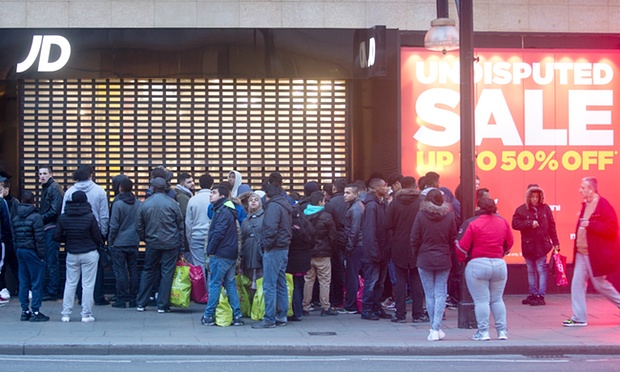
‘While we may scorn on the queues in front of the shops, for many, those sales provide the one chance to buy items they’ve needed all year.’ Photograph: Teri Pengilley for the Guardian
‘While we may scorn on the queues in front of the shops, for many, those sales provide the one chance to buy items they’ve needed all year.’
Photograph: Teri Pengilley for the Guardian

Originally published in The Guardian, 16 December 2015

It’s a tradition now as strong as the trees, snowmen, carols, and dare I say it, the presents. Each year, bolstered by a growing anti-consumerist movement, people are using the holiday season to call on us all to shop less.

“Try buying almost nothing for Christmas and you might experience the most joyous holiday season you’ve ever had,” the anti-commercial magazine Adbusters says. “Bake them a cake, write them a poem, give them a kiss, tell them a joke, but for God’s sake stop trashing the planet to tell someone you care. All it shows is that you don’t,” argues George Monbiot.

Don’t shop this Christmas, for the sake of the planet.

Driven by concerns about resource depletion, over recent years environmentalists have increasingly turned their sights on our “consumer culture”. Groups such as The Story of Stuff and Buy Nothing New Day are flourishing as a movement that increasingly blames all our ills on our desire to shop.

But will a “buy nothing Christmas” actually help the environment?

We clearly have a growing resource problem. The products we make, buy, and use are often linked to the destruction of our waterways, biodiversity, climate and the land on which millions of people live. But to blame these issues on Christmas shoppers is misguided, and lands us in the old trap of blaming individuals for what is a systematic problem.

How can we attack people for buying a new car for example, when lack of investment in public transport makes it almost impossible to get around by any other means? How can we blame individual shoppers for the impact of Coltan mining in Africa when it’s now virtually impossible to buy a phone or computer without the important metal? This is particularly true given evidence that phone companies design their products to slow down or die after a couple of years, forcing people to buy new models. In a world increasingly based on mobile technology, are we now expecting people to go without a phone? Who gets to keep their phones, and who doesn’t?

The same can be said for so much of our consumption patterns. We can’t blame individuals for buying clothes made with sweatshop labour when stagnating wages make them the most, if not only, affordable option. We can’t blame people for buying more kitchen appliances when increasing work hours make every minute at home increasingly valuable.

Environmental problems go much deeper than how much we buy, and when. Talking endlessly about a “consumer culture” does nothing to solve this, blaming individuals for problems that actually lie at the level of government, big business and the wealthy.

In ignoring these issues, campaigns for a “buy nothing Christmas” amount to nothing more than an attack on the working class.

While we rant about environmental destruction over Christmas, environmentalists often forget what the holiday season actually means for many people. For most, Christmas isn’t an add-on to an already heavy shopping year. In fact, it is likely the only time of year many have the opportunity to spend on friends and family, or even just to buy the necessities needed for modern life.

This is particularly true for Boxing Day, often the target of the strongest derision by anti-consumerists. While we may scorn on the queues in front of the shops, for many, those sales provide the one chance to buy items they’ve needed all year. As Leigh Phillips argues, “this is one of the few times of the year that people can even hope to afford such ‘luxuries’, the Christmas presents their kids are asking for, or just an appliance that works.”

Who can blame people for wanting to take advantage of these deals when it means the difference between having a much needed item, and not?

The richest 7% of people are responsible for 50% of greenhouse gas emissions.
This becomes particularly pernicious when you take into account that those shopping on Boxing Day are only a fraction of our consumption “problem” anyway. Why are environmentalists attacking these individuals, while ignoring the likes of Russian billionaire Roman Abramovich, who has his own £1.5bn yacht, which is equipped with a missile defence system?

Or what about Jamie Packer, who recently sold his Vaucluse mansion for a whopping $70m? This year stories appeared about Packer’s new life in Israel, including information about his “relatively small” mansion in the town of Caesarea that he has revamped with a new swimming pool and entertainment area.

Even our favourite anti-poverty billionaires engage in this sort of conspicuous consumption. In 2014, for example, it was reported that Bill Gates had taken his family on a holiday aboard the “Serene”, a US$330m yacht that he was renting for $5m a week. Gates recently finished building his new mansion in the United States. Worth US $123m, Gates’ new home includes an underwater sound system in the pool and an $80,000 feature that allows you to change the artwork on the walls with a touch of a button. It was reportedly built with 500-year-old Douglas fir trees.

When it comes to needless consumption, the rich far outweigh the working class. Data out of the United States shows that the bottom 10% of Americans spend 60% of their money on the basics of housing and food. The wealthiest 10%, however, only spend 40% of their money on these items. This leaves a lot of money available for consumption on private jets, expensive holidays and missile defence systems.

This has an impact. Research from 2009 showed that the richest 7% of people are responsible for 50% of carbon dioxide emissions. The gifts bought by the working class over Christmas have little impact compared to the fuel needed for a private jet trip around the world for the rich, yet somehow they miss out on the criticism.

This is the problem for the anti-consumerist movement. While our overly productionist society may be at the root of many of our environmental problems, we are targeting the wrong people. Instead of campaigning against the companies cutting corners, governments that aren’t funding other options, or the wealthy who are buying multi-million dollar yachts while many others can’t afford the basics of life, we’re attacking working class people who simply want to enjoy the holiday season.

In doing so, anti-consumerism has become a movement of wealthy leftists talking down to the working class about their life choices, while ignoring the real cause of our environmental problems. It is no wonder no one is changing their behaviours – or that environmental destruction continues unabated.

Newsletter #1: Travel, research and catching up on life

I’m starting a new newsletter to keep you all up to date on my work, writing and activism. The newsletter will be coming out once a month with updates on everything I’m doing. You can subscribe here, or just out my first one below!

Dear friends,

Wow! What a year! 

Firstly, apologies for taking so long to get this newsletter out. Just to confirm, you are on this list as you donated to my campaign to write Sexy Capitalism. As you probably all remember one of my promises was a monthly update on my work, and so far I have been extremely slack. But here we are with newsletter #1. The end of the year seems like no better time than to get started! 

Lots of travel

Let’s start with some excuses. The Sexy Capitalism crowd funder finished in September, meaning it has been almost three months since it was done (I can’t believe it was that long ago!). So why the silence? 

Well, some of you may remember I have spent the last year living in Edinburgh, and the last few months have been crazy. I spent all October living in Berlin and studying German, followed by two more weeks in the UK before I headed on holiday to the United States. I am now back home though, settling back into Canberra and getting back into a good working schedule. 

But what about the book? 

Don’t worry! This doesn’t mean I’ve been spending all your money on traveling while not doing anywork. Since the fundraiser I have made significant progress on Sexy Capitalism and am feeling confident about the next steps. 

Here is where I’m at so far: 

  1. Doing some base research.  

This book is going to require a lot of research and I am diving head first into a lot of reading. So far I’ve done the fun things like setting up a research tracking system and developing lists of things I need to read and people I want to contact. Now I’m starting with the research proper. 


As I write I am also reading Michèle Barrett’s Women’s Oppression Today, a classic marxist-feminist text, which is in particular important for establishing the idea of the “family-household system”, a structure: 

 in which a number of people, usually biologically related, depend on the wages of a few adult members, primarily those of the husband/father, and in which all depend primarily on the unpaid labour of the wife/ mother for cleaning, food preparation, child care, and so forth. The ideology of the “family” is one that defines family life as “ ‘naturally’ based on close kinship, as properly organized through a male bread- winner with a financially dependent wife and children, and as a haven of privacy beyond the public realm of commerce and industry.”

Barrett is one of the key writers in describing the family not just as natural but a political structure, one shaped for the needs of our economic system. She is key in fusing modern feminism with Marxist thought. I will be writing a review of Barrett once I’ve finished, which I will include in my next newsletter. 

2.   Developing a structure and working on the first two chapters

My key project for the moment is working on proposals for potential publishers. This requires a book structure and outline, as well as a completed first 2 – 3 chapters. I now have a draft outline developed on a spreadsheet and am working on chapter summaries. This outline works largely through a historical prism, tracking the nature of families, sex and sexual oppression through the period from the rise of industrial capitalism to the modern day. I will be overlaying this historical analysis with an materialist and ideological framework, infusing the key thinkers in these areas.  

On top of this I am working on the first two chapters of the book. Chapter one will be a summary of sexual relations as they exist today. Here I describe what I call the “sexual paradox”; a description of our social system in which both family values and sexual freedom are co-existing in a fundamentally awkward, yet necessary (for capitalism) alliance. This paradox, or contradiction, I believe is inherent in capitalism and at the same time one of the major weaknesses of the system. 

Chapter two will start our history lesson. It will start by looking at sexual relations in the periods prior to capitalism, starting briefly with early sexual activity (and the theories of Friedrich Engels) and then to look and sexual life prior to the rise of industrial capitalism (around the 1700 and 1800s). This will give us our base from where to launch into our analysis. 

Both of these chapters are on their way and I will look to have them finished some time in the early new year!

Other work

On top of all of this I am still working on other projects, and in particular my first novel,Forgiveness. I am in the middle of my second draft of Forgiveness and am planning to have this done by April next year. Keep your eye out as I send more information on this in the future! 

Also, If you’ve missed them so far, you can check out some of my latest published pieces: 

Get in touch!

Got any questions or thoughts, then get in touch. You can email me at simon_copland@hotmail.com and make sure you also check me out on Facebook andTwitter

Have a great holidays and see you all next year.