
A Malcolm Turnbull comeback would not be good for the left

Malcolm Turnbull: not that progressive?
‘Turnbull has taken on an almost hero-like persona within a particular part of the progressive community’. Photograph: Lukas Coch/AAP

Originally published in the Guardian Australia, 19 July 2013

And so it has begun. Michael Short made the first real foray into the debate this week, arguing that the Liberals would be wise to replace Tony Abbott with Malcolm Turnbull. Bob Ellis was quick to follow, arguing that Abbott’s “invisible substance” gaffe may lead to his end. And with Kevin Rudd currently enjoying good poll ratings, people have started to salivate at the thought of a Turnbull return.

Interestingly, a significant part of this push has come from the left. Ellis is a Labor man, and if you quickly scan the hashtags #libspill or#reTurnbull on Twitter, you can spot a raft of lefties pushing the idea of Turnbull making a comeback. Much of this is comes from a hatred of Abbott, but a lot more is due to a love for Turnbull. As Short argues:

As a former leading businessman, Turnbull has appeal in the corporate sector. As a former leading internet entrepreneur, he has appeal to younger people. As a moderate, he appeals to the many voters who are uncomfortable with what they feel are unduly harsh policies on asylum seekers, to those who suspect Abbott would screw down on workers’ entitlements by toughening up industrial relations policy and to those who favour action on climate change.

It is important here to point out some blatant hypocrisy. There is something particularly special about people who a few weeks ago were calling the ALP leadership spill a “made-up media frenzy” to then turn around and try to push leadership speculation based on a few polls. It is awful to tear down Julia Gillard’s leadership because she was leading the government to a catastrophic defeat, but it is okay to do the same to Abbott because the polls are now tied? Paint me confused.

But hypocrisy aside, I cannot help but question the progressive logic behind having Turnbull as Liberal party leader. Ever since he was dumped in 2009, Turnbull has taken on an almost hero-like persona within a particular part of the progressive community. He fell on his sword in a fight for climate action, and then became one of the first Liberal MPs to come out for marriage equality. He is a Liberal who has taken on important progressive causes, and has been rewarded by progressives even since.
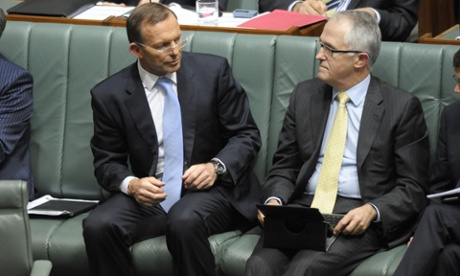
Tony Abbott speaks to Malcolm Turnbull during Question Time.
Tony Abbott speaks to Malcolm Turnbull during Question Time. Photograph: Alan Porrit

Problem is, it is ridiculous logic based on a false image of the man.

Let’s gloss over the fact that it was Turnbull who presented amendments that significantly watered down the Carbon Pollution Reduction Scheme. We would also have to ignore the very structural issues of queer discrimination that will forever exist in the Liberal party – the very party we want Turnbull to lead. Simply put, Turnbull’s support for climate action and marriage equality are certainly not as strong as they could be.

But what about the rest? Turnbull is extremely pro free-market, and is anti-union. He voted for Workchoices and as prime minister would very likely cut welfare programs. His ministerial team, including the likes of George Brandis, Peter Dutton and Eric Abetz, would still have all the elements of a rabid right-wing Liberal machine. As Liz Humphrys explains:

Turnbull is committed to privatisation of the public sector, radical industrial relations policy, and solving serious social problems (such as climate change) by leaving them to market mechanisms. He has even gone so far as to call building the National Broadband Network ‘the telecommunications version of Cuba‘.

When you look at it like this, you can see a basic political failure from those who claim to be progressive and who hope for a Turnbull return. The logic should be simple: if you have an opponent that is largely disliked (as Abbott clearly is), as progressives, you shouldn’t encourage a switch to a more popular alternative.

But instead, we have a new form of progressivism forming – one obsessed with symbols over structures. And Turnbull has become one great symbol. As Helen Razer argued earlier this year, “the left now hungers for symbols of cultural identity and spurns the idea of class.”

I would disagree that it is the left that is now doing this (as I’m not convinced “progressives” and the “left” are the same thing), but the basic theory is true; progressives have turned away from class and structures, and towards symbols. Again, as Humphrys argues:

While progressives have been speaking out on crucial social issues (from mandatory detention of refugees to tackling climate change), we have often done so in a way that fails to challenge the dominant economic framework that underpins these problems. We have let the rich and powerful pursue their economic agenda effectively unchallenged.

This is the sort of progressivism that cares about the climate, but refuses to challenge the structures (for example, neoliberalism) or institutions (say, the fossil fuel industry) that perpetuate the climate crisis. It is a brand of progressivism that cares about gay people, but is resistant to challenge the underlying structures – and by that I mean the heteropatriarchy – that are the foundation of queerphobia. It is the sort of progressivism that champions same-sex marriage as a conservative vote winner, without acknowledging that it is the very conservative nature of marriage that feminists have been fighting against for decades.

So let’s not kid ourselves: Turnbull as a Liberal leader would be more likely to win an election, and in doing so would take the country far further to the right.

It may be fun to watch a Liberal leadership spill before the election; I think I’d enjoy it. But if the left thinks this is the way to achieve a progressive victory, it is sorely mistaken.

Istanbul Pride

As I’ve said in a few of my posts, whilst in Turkey I went to Istanbul Pride. I went with a big group of people from Global Power Shift and it was just amazing. Instead of doing a reflection or similar I decided I’d share the video I took from the rally (check out some of my pieces in Sydney Star Observer on Istanbul – Istanbul! (Or how I managed to get caught up in a Turkish pride march) & another that doesn’t seem to be online – I will try and get it soon). I think the video will do more justice that anything I can write.

A few notes. The rally attracted about 50,000 people – a huge turnout. We marched from Taksim Square (the infamous Square, whose destruction sparked a national movement over the last 2 months) and headed down the Istiklal – the main street in Beyoglu – or the new town. At the end, we sat in a Square, dranks beer, and then danced at Istanbul’s only gay and lesbian bar, and then at a bar called ‘Topless’ until about 4:30 in the morning. It was a great night!

You will here a few chants in the videos. The main ones were (translated):

– “This is just the beginning. The resistance will go on.” – This is the main chant from the protest movement in Turkey over the last month or so.

– “We will not be silenced. We are gays and lesbians”, and my personal favourite:

– “You better escape, the faggots are coming.” This one was best used when we walked passed a group of Islamofacists who were engaging in a counter-protest.

Anyway, here is the video. Enjoy! (p.s. if you’re a fan of cats, make sure you watch the last video!)

[youtube=http://www.youtube.com/watch?v=x9t_jUOO4vE&w=560&h=315]

At the start of the rally as the crowd gathered we went to Burger King and watched from their balcony. You can see the energy in the crown.

[youtube=http://www.youtube.com/watch?v=dR-O6pXfJU8&w=560&h=315]

One of the favourite ‘actions’ of the crowd was to sing a song (I don’t know what it was) whilst everyone jumped up and down. It was really fun, and here you can see it in action from above. With such a big crowd, the action went in waves. It was quite amazing!

[youtube=http://www.youtube.com/watch?v=xayWfoA50s0&w=560&h=315]

This is just a great example of the key chant ‘Bu Daha Başlangıç Mücadeleye Devam’ in action. This means, ‘This is just the beginning, the resistance will continue’ and has been the catch cry of the Turkish movement. It doesn’t start until about 1/2 through, but you can get a real sense of the power of it.

[youtube=http://www.youtube.com/watch?v=heA9uyG3XHA&w=560&h=315]

Don’t really know what was happening here – but this part of the crowd was doing this and enjoying it!

[youtube=http://www.youtube.com/watch?v=XDEVxk4RlPk&w=560&h=315]

Just come great chanting and noise here

[youtube=http://www.youtube.com/watch?v=l84-1Un8LrI&w=560&h=315]

And finally, rally chant cat! This can was in charge of letting everyone know the chant words.

I’m back! The world is a wonderful place

Back home!

As I have been blogging I have just spent 3 weeks away in Turkey and Jordan, and have finally made my way back home to Brisbane. I’ve been thinking a lot about how I can wrap up my trip, and have been struggling. It was such a diverse and interesting experience that I don’t really know where to start. So instead of going through everything in detail, let’s talk about how wonderful the world really is.

I reckon we can get a pretty awful picture of the world these days. War, disease, famine, environmental destruction – everything looks awful. I hear it so often – ‘the world is a terrible place’. We talk about this in our own politics – everyone hates Australian politics and the awful things we do. Everybody is seen in such a cynical light – humans are awful beings. But we talk about it more when we look overseas – we see places like the Middle East and think ‘what an awful world we live in’.

Now, I’m not denying there are awful things that happen in this world. Watching the events of Syria and Egypt recently I cannot help but be depressed (as were the people I met in the Middle East). But coming home from a good trip I cannot help but think that behind all of this, there is some sort of wonder to this world too.

If you wanted to look at awful things happening in the world, then Turkey is probably a good place to start. Police violence against protesters has lead to seven deaths (I think that’s the latest count), and when I was there 30 people had lost eyes due to police action. The Government is considered to becoming more authoritarian and conservative – against the people’s wishes. It is a sign of potentially awful things to come.

But within the bloodshed and pain I saw a movement of amazing quality. People were coming together as a community to fight not just for themselves – but for their community. As I was leaving Turkey, the Islamic holiday Ramadan was beginning (it goes for a month). Ramadan involves a fast during the day, and feasting after the sun goes down. On the first night activists involved in the gathered on the main street of Istanbul to have a community feast. Anybody and everybody was invited to bring food, and a huge feast ensued (unfortunately I missed it). It was the sort of vibe I found throughout Turkey – a community coming together to campaign collectively for their community. A really wonderful community.

In Jordan I stayed with a Palestinian family on the edge of Amman. The family had little in terms of possessions. Six people crammed into a two bedroom apartment. Yet, they were the most welcoming and open people I think I have ever met in my life. They were excited to have me stay and would have done anything for me whilst I was there. Every night friends, family and members of the community would come around just to hang out – a great sense of their community.

You could see it all around Jordan. It is a country that has gone through its struggles – it is still going through struggles. But the community survives, and more than that – the community stays as one of the strongest communities I’ve ever seen.

There is something great about seeing other parts of the world. You get some sort of different perspective. It’s often even better to visit the places that you think are doing horribly – that are suffering under terrible fates and you have no idea how people survive.

Yes, there are bad things in this world. People undergo true hardships. There is so much to fight for. But if I could say anything for my trip, I think it reminded me that in the end the world, and people, are pretty wonderful. We live in a wonderful place and people are wonderful beings. It’s useful to remember that sometimes.

ps. I have some more posts about the trip I am intending to get up soon – particularly some videos from Istanbul Pride. Otherwise it will be back to my usual political ranting (with something different in between).

Global Power Shift – Wrap Up

When thinking about climate change it can often be easy to get caught up in our own small world. What is our own country’s per capita emission? What can I do as an individual to solve the problem? What is my Government doing about it all?

Each country around the world is fighting its own battle against climate change.  As Bill McKibben highlighted in his tour of Australia last month, Australia plays a very important role in the maths of global warming.  As home to one of the great carbon stores in the world, the decision whether or not to continue the expansion of Australian coal mining and exports will affect the whole planet.   It is easy to get lost in our local agendas but we cannot forget how global this issue really is.  These local, national fights are all part of one huge global battle.

This hit home to me over the last week as I attended the 350 conference, Global Power Shift. The conference brought together 500 people from around the world.  With 132 countries represented, Global Power Shift facilitated a truly international discussion on how we can tackle climate change – as a global community.

It’s really difficult to summarise the events of the conference. In essence it was not really a discussion about specific climate policy or action, nor was it just about learning new things about climate change.  The focus was much more on strategy.  What are we all going to do about this problem?  How are we going to initiate the necessary change?

If there is anything I will take out of GPS it is a reaffirmation of the global importance of climate change. Not just global in the way that climate change will affect us all – but global because of the role we will all need to play to solve the crisis we are facing.   In each individual country we might be fighting a slightly different fight, in Australia to halt coal mining, in the Pacific to stop sea levels rising, in the US stop expansion of an oil pipeline, whilst in India and Turkey they are trying to defeat the coal power plants Australian coal could power.  As everywhere around the world is part of this problem, so too must we all be part of the solution.

After hearing all the delegates at the conference the main take home messages for me were as follows.

Firstly, whilst a significant chunk of the political debate about global warming has focused on which countries have played a larger role in greenhouse gas emissions compared to others, it has become clear that there is a common international enemy in this fight which knows no national boundaries.   This common enemy is the fossil fuel industry and the global structure that allows them to continue to operate in the way they do.

At GPS we heard stories from all around the world that paid testament to this. In Australia companies are digging up the land for coal, in Canada they are digging up the tar sands – and in places like India, China and Turkey – they are both digging coal up and relentlessly pushing to burn it as much as possible. The fossil fuel industry has become a rogue force – and through the massive power their hold, they have been literally given permission to become a threat to our society.

What GPS showed us is that now we have identified this common international enemy we have a real focus on which to target our energies and a renewed capacity to work together to solve the climate problem. As a global movement, with a global enemy, we now have the opportunity to make change happen where it counts.

Going into GPS I wasn’t sure what I would learn from delegates traveling from far-flung places like Asia, Africa or the Middle East. I thought perhaps we wouldn’t have much in common, that our systems would be too different for us to find common ground. But I was wrong.

At the end of the week, participants from all the different countries developed posters so we could see the plans they were taking home to get active on global warming. The plans were nothing short of inspiring and some truly amazing coming from many countries where resources are so much more limited than here in Australia.

Despite the various cultural differences, what was amazing was how similar our campaigns can be. The issues – divestment, coal, oil and gas and Government legislation – are pretty much the same the world over and thus the tactics – media, non-violent direct action, volunteer mobilisation, creative activism – are similar too. In this way we have so much we can learn and share with each other, from anywhere in the world. GPS has given us the opportunity and the vision to move forward sharing and cooperating to find a global solution.

And this I guess builds into a final message I will take from GPS.

One of the catch crys of many in the fight against climate change is that “this is the most important battle of our generation,”and  the one on which our full attention needs to be focused.  While it is incredibly important, climate change is not the only problem that the world faces.  As this time of turbulance in Istanbul has shown me there are many crucial issues  and campaigns for justice, be it human or environmental, that are being waged all over the globe.  Climate change is just one, albeit large, piece in the puzzle of a system that upholds so many abhorrent practices.  Perhaps it is the system then that we should really be focusing on.

Global Power Shift was a big week – something I struggle to cram into 1,000 words.  I have shared here a few of the lessons I have learned but I hope that I will be able to impart even more in our campaigns in the future.


My night as part of the Turkish protest movement

So you know the thing where you do something that everyone has told you not to do? Well, here is my story of doing that thing. Here is my story of (at least for one night) joining the Turkish protest movement.

Last night was our one night off at Global Power Shift. I have to say people were pretty excited about it (just to get away from the campus where we are staying) and plans were afoot. With some locals with us, we decided to go to a General Assembly in AbbaSaga Park and then after that head out to a bar.

Let me explain the general assemblies. As you may be aware, the spark for the recent Turkish protests were plans from the Government to tear down the central Gezi Park to build a shopping mall and a reconstruction army barracks from the Ottoman Empire era. Gezi is, from what I understand, the largest park in central Istanbul (and trust me, there aren’t many parks here) and has been a central meeting point for the community for a long time.

The protests therefore originally focused on Gezi Park and the adjacent Taksim Square. The demolition plan was a spark to create a national movement, and therefore Gezi was the focal point of the movement. They started off as protests and then moved to to an occupation. Then, as seen across the world, a couple of weeks ago the police cleared it out. Today the park is closed – there are police spread throughout Taksim Square and Gezi is blocked off – with police sitting inside make sure no one enters. Because of this, the movement have decided to spread themselves out. Unable to occupy Gezi they have decided to take over the other parks in the city – I think about 40 or so occupations. And as part of this, there are general assemblies in the parks every night – yes, that’s right – every night! The park we went to, AbbaSaga, in the suburb of Besiktas, about a 30 minute walk from Taksim, is the largest of these gatherings. If fact, it seems as though Besiktas is the new central point of the movement.

So, with a desire to see the movement in action, we decided we’d head to the general assembly, and then head out for a drink. It started at 9pm, and we’d been told they normally last for 1/2 hour to an hour. With some Turkish friends we had some good translators to help guide us through what was going on.

From the moment the assembly started however it became clear this wasn’t just going to last for 1/2 hour. I’ll quickly explain how it seemed to work. The assembly was in a park amphitheatre. There were a few designated facilitators with everyone sitting around listening. People were given hand signals – putting your hands up in the air if you agreed with something (twinkle fingers) and make a cross with your hands if you disagreed. People were also able to speak and provide counter-proposals. On key issues there was a vote.

The general assembly

As it started our translator informed us that the discussion was focused around when to head back to Taksim Square. From what I understand, originally the discussion was to go there on Saturday. Bring people together for one big push. Then someone proposed Friday. And then someone proposed they did it tonight. Votes were had and it seemed as though the decision was made to go tonight. Things suddenly got very real.

The next five or ten minutes or so I got lost, but as I got back into the conversation it became clear the plans had changed. Now, instead of going to Taksim, a plan had been hatched to march about 20 minutes away to a major media outlet that has been very favourable to the Government. They would protest outside their office, potentially do a sit-in and then march back. The plan was agreed.

For the next hour our group (of about 40) discussed whether we wanted to join and there was agreement amongst most of us that we would do so. In the meantime the general assembly continued – they discussed filling their legal working group, the actions of their women’s working group, supporting the upcoming Pride festival and other issues such as making demands around education and planning other potential actions. The plan was to leave for the protest at 10.

At about 10:15 we got ready to go. As everyone started gather we were informed by our Turkish friend that the police had been tipped off on the plans and had already stationed themselves at the media office with water cannons and trucks they called ‘Scorpions’ – the riot trucks used to separate crowds. My heart rate increased significantly, but I decided I wanted to continue. We would travel as a group, stay at the back of the march, stay away from the police, and disperse the moment we saw the police do anything.

I have to say I have never experienced a protest like this. It was truly inspiring. There were probably about 300 – 500 people marching, but the support was much stronger than that. Since the protests started it has become tradition that at 9pm supporters of the movement would bang pots and pans together in a show of support. It makes quite a noise. With the march now on the streets, this tradition continued, and supporters came out onto the street, poked their heads out of their windows, or stood on their balconies clapping and banging their pots and pans together.

On the march
On the march

The march walked up a residential/commercial street – bars on the ground floor and houses above, and then came out onto a major six-lane road. It was here were I started to get nervous. As we entered the highway we saw a scorpion drive past – making their way towards to the media office. My heart jumped a beat the moment I saw it.

But we continued on. After about ten more minutes we made it to the media office. Marching along the highway there were countless cars beeping their horns in support. The sound was stunning. As we got the media office the crowd coalesced around the office blocking off two lanes of traffic. At one end a large police van sat in the middle of the crowd – I could see the water canon on its roof. I could also see numerous riot police – with their dark clothing and shields ready in case something happened. The crowd chanted loudly for about 10 minutes or so – I don’t quite know what they were saying, but it was great to watch.

Then, the person with the megaphone made an announcement, and extremely quickly the protesters turned around and made their way back to the park. I don’t think the sit-in happened. I think they decided to pick their battles and it wasn’t worth it this time. As far as I could tell there was no violence and there were no arrests.

It’s hard to explain through writing how exciting and inspiring this was. Luckily I have some footage I took, which I intend to share once I have sorted through it (I am just about to fall asleep and have no energy to do that now). Otherwise, there are two things I think I can take from my experience.

1.) This is not just a bunch of rabble-rousers.

The biggest take away for me from this experience was how broad the support in Istanbul for the movement is. As I said, as we marched people were banging their pots and pans and honking their horns. But maybe I didn’t explain it well enough – this was not just a few people doing it. It was most people doing it. Almost every balcony had people standing and showing their support. Almost every car was tooting their horn in support. It was huge. And it’s not like it felt like this was a unique area – the road was a major highway, bringing people from all across the city. And they were all beeping their horns in support.

Therefore, unlike so much of the discussion around these movements – this is not in its own a movement of rabble-rousing youths. One of the most inspiring stories I have heard since being in Istanbul comes from a few weeks back. Apparently, in the peak of the occupation of Gezi Park, the Governor of Istanbul went onto the television and pleaded with the mothers of those occupying the park to come out onto the street and bring their children home. To remove them from harms way and to get them to stop causing trouble. Instead however, mothers from all around the city came to the park, joined hands, and formed a circle around their children to protect them from harms way. To protect them from the violence of the police. It is truly inspiring.

It is this spirit I saw last night. Everyone was out – from 18 year olds to 80 year olds. This is a broad movement.

2.) The movement here is extremely democratic and it is being sustained. Watching the General Assembly was extremely inspiring, and the discussions around the broad range of topics – from developing a lawyers group to supporting Pride week – show how broad, and how democratic the movement is. I can’t go into all the details, and I am sure there are issues. But it feels like the momentum is not being lost and that a large part of that is the open way it is being run. Watching it last night made me feel like it was the way movements should work.

I’ve got two more actions I am heading to this weekend – a climate action prepared with local groups as part of Global Power Shift and the Pride march on Sunday (which we have been told is expecting 50,000 people!). I will report back on both!

What is violence?

Okay! So finally some time to talk about the content at Global Power Shift.

As I have said in previous posts, during the event we have all split into different ‘tracks’. The track I am in is Non-Violent Direct Action (NVDA). One of the great things about NVDA is that to be able to do it effectively you have to be able to have the philosophical discussion about it first. You have to be able to constructively discuss the questions; what is violence, and is violence ever justified?

Yesterday we dove into these questions and I want to pull out a few thoughts bubbling around in my head.

I have to say, starting off, I was slightly disappointed with the level of interaction around the question of ‘what is violence?’. Many seemed to take a really simplistic approach – “it is physically harming others”, or “it is vandalism or the destruction of poverty” were the two key responses. Reverse the question and we were unable to genuinely ask ourselves “what is non-violence?” – the best we could come up with were the ideas that non-violence (in the context of social movements) were ‘peaceful rallies’, ‘sit-ins’ or similar. Coming from this conversation I have really thought in depth about the question of what is violence, and have had two thought bubbles.

Firstly, the major issue I think we missed was that violence only exists in relation to power structures. Power and violence are inherently interlinked – it is those with power who are best able and most willing to inflict violence on our society – whether it is police attacking protesters, or major companies destroying the lands of farmers. As someone in our stream yesterday said (paraphrasing), “when you gain power, you do all you can to keep power – and often that requires violence”. This is something I have spoken about before in this blog – in the past in reference to political protest movements. As I argued:

In his book ‘Violence,’ philosopher Slavok Žižek argues that our society tends to focus on what he calls ‘subjective violence’ – acts of assault, murder, terror and war. In doing so, we ignore two other forms of violence in our society, ‘symbolic violence embodied in language and its forms,’ and systematic violence, which he states are the “often catastrophic consequences of the functioning of our economic and political systems.” These forms of violence are what are described as ‘structural violence,’ or the violence embedded in our society through the way it operates.

We can see Žižek’s theory in play when we discuss modern protest movements. We are very quick to condemn violence when it involves at the Seattle World Trade Organisation ‘riots,’ the riots in London or the Tent Embassy protest on Australia Day, without commenting on the ongoing systematic violence conducted by the World Trade Organisation, the British economy, or the 200 year oppression of Aboriginal people. We criticise queer protestors when they engage in violent acts, whilst ignoring the symbolic violence embedded in the homophobic language that still dominates our society today.

Violence therefore is not just hitting people or destroying someone’s property – it systematic in our society, and hurts those without power the most. In doing so therefore we must recognise that violence is subjective – what I view as violence (destroying the environment), others may view as ‘development’. What I may view as ‘the defence of the planet’ (obstructing coal developments), others may view as the destruction of private property and therefore ‘violence’. Importantly this means that, as there is no such thing as an action without consequences, anything (in particular for social movements) can be considered violent. Anything that has a negative impact on another can be considered violent.

And idea that violence is just ‘hurting others’ therefore can actually have a real negative effective – perpetuating the systems that inflict the most violence. If we don’t take symbolic and systematic violence into we end up with debates about whether a protester throwing rocks at the police was ‘too violent’, ignoring the very real systematic violence that that protester has likely face for their entire lives.

This then builds into a larger question of what are the boundaries? Given that violence is subjective and that we can frame almost any action, particularly one that aims to tear down societal systems, as violence – where are our limits.

I have to say I have no idea of the answer to this question, but I have to say I am not as fully convinced of the hardline ‘non-violence’ approach many like to take. I am not suggesting we engage in environmental terrorism to solve climate change, but rather that we need to have a serious and nuanced approach to violence – one that can take in the subjectivity inherent in the subject. We need to recognise that non-violent direct action, and civil disobedience, will, no matter what we do, be considered a form of violence by someone. And in doing so we need to find a way to come to peace with this.

It is in coming to piece with this that I would like to take some guidance from Saul Alinsky. I did a review of his piece Rules for Radicals for my friend Holly Hammond who runs Plan to Win a little while ago. Looking back on it, I found a section that I think is a valuable way to end this discussion (rather than me re-writing it all). Here goes:

“One of the most interesting areas in this discussion is his work on how radical organisations can justify means in order to achieve their ends. When discussing means and ends, Alinsky states:

“That perennial question, “Does the end justify the means?” is meaningless as it stands; the real and only question regarding the ethics of means and ends is, and always has been, “Does this particular end justify this particular mean?”

In other words, Alinsky argues that there are no clear lines for defining what ‘justifiable means’ are, but rather that justification is dependent on the context of the campaign and issue. This is particularly relevant given the power structures in our society, where those who are fighting for change (who are often the ones who get caught up in discussions about the ethics of means and ends) are fighting against people with a large amount of power who often have little care about the ethics of their means. Alinsky therefore states that:

“The practical revolutionary will understand Goethe’s “conscience is the virtue of observers and not of agents of action”; in action, one does not always enjoy the luxury of a decision that is consistent both with one’s individual conscience and the good of mankind (sic). The choice must always be for the latter.”

Alinsky develops this idea further by outlining a range of rules for how organisations can determine the ethics of their means and ends. Two key rules are:

“The third rule of the ethics of means and ends is that in war the end justifies almost any means.”

“The ninth rule of the ethics of means and ends is that any effective means is automatically judged by the opposition as being unethical.”

The discussion on means and ends is just one area where Alinsky challenges much of the dominant discourse around movements for change. Throughout his work, Alinsky argues that much of our strategic decisions about ethics are made out of context, and that this is not a practical way to achieve change. And this is what is so important about his work. In many ways Alinsky’s work is an analysis of flawed approaches to social change (even today) and a call out for change. The great thing is that he also provides realistic, radicals ways for this to be achieved.”

I’m certain I am going to have some more thoughts on violence as we get into this debate. But this is a good start.


Watching Australian political chaos whilst in Turkey

I was rather excited for today. It’s interesting – if I had been in Australia I am sure I would have spent my time watching the Rudd/Gillard developments as closely as possible. I am sure there have been speculation articles in the lead up to today’s showdown, and I am sure I would have found them. For some reason I like to read that stuff. But there is something about getting on a plane and going overseas – I sort of forgot it was happening.

And then there was today. By the time I had woken up and gotten into our workshops, and then connected to the Internet, everything was in full swing. Suddenly, after it had completely passed from my mind (even though I had been discussing this in full detail only a few days ago), we had a new Prime Minister. A completely new political situation.

I can’t explain how frustrating it is to try and sit through conference sessions when you mind is really just focused on what is happening on the other side of the world. When all you want to do is get onto Twitter and live stream ABC 24 (which I couldn’t do because the Internet connection was failing today). I couldn’t get away from it – I wanted to be there – not here.

I know there are so many people are so frustrated with this – who are sick of all the internal fighting. People who couldn’t stand watching the TV screen. People who just wanted to scream. I get those feelings. Yet at the same time, it is strangely hard to be on the other side of the world when such a big political shift is happening at home.

I cannot quite explain how I am feeling after it is all done, whilst everyone in Australia is asleep. I think there are two thoughts.

The first is relief. As I have explained before I have a strange emotional connection to the Julia v Kevin fight and that has dissipated. I am however feeling rather relieved that it is all over – that at least this fight is finally done. That we can maybe move on. But more importantly that we can have the election we deserve – the election I kind of wanted in 2010.

The second thought though is panic. What the fuck is going to happen whilst I am asleep tonight? I am hoping to all hell that an early election isn’t called – whilst I may like it in theory the idea of watching an election whilst I am overseas is a bit too much to bear (I look forward to a life where I can really disconnect). I am hoping I can get through the next two weeks without feeling like I need to come home.

In the meantime though I will continue on at GPS. And I am finally going to get to some content. Expect a piece on violence very soon!

Conference anxiety

There is something I often find when coming to conferences like this (for a reminder, I am at Global Power Shift in Istanbul). No matter what I do, no matter how strong my mindset is, no matter what I want to focus on, I always get anxious about what I am missing out on. What if I picked the wrong session? What if I am missing out on something amazing?

Today, the first full day of GPS, that anxiety hit me with a full force. As part of the week we had to pick one track out of five options. I chose non-violent direct action (NVDA) ahead of the other opportunities; media and communications, digital campaigning, policy and creative activism. My process of deduction was pretty clear – I had no interest in creative activism or policy, and of the remaining three I felt like I knew less about NVDA than the other two options. It was an opportunity to learn.

But, my brain doesn’t work in that way. And today, particularly in our first track session, my brain refused to work that way. I spent the entire time somewhat freaking out about whether I had picked the wrong track. I work in media and comms I thought – I should be doing that. I should keep focusing on what I know, not try and expand my knowledge. I’m spreading myself too thin.

I don’t write this to give you great insight into my sometimes odd brain, although it does feel good to put it on paper (so to speak). Rather, in thinking and dealing with my anxiety, I started to reflect on how this idea plays out in general society. You see, it is not just at conferences where I feel this anxiety. It happens to me all the time.

For example, last night after our welcoming plenary, I went back and sat in my dorm room and watched Game of Thrones on my computer. I was tired and I needed a break. I am probably going to do the same thing tonight (I have the entire second season on my computer).  Yet, as I sat there, on the other side of the world, watching a TV show I could be watching at home, I couldn’t help but question what I was doing. There is nothing, I know, wrong with having a bit of a break. But, at the same time, my mind bothered me. Whilst I am here, I suspected that there were people in Taksim Square protesting (hearing reports, I think I may have actually been wrong). In my first evening at GPS, I heard many stories of people who have been caught up in the protests one way or another. People who have real stories to tell. And all I could think was that all I am doing is sitting here, doing nothing (please note, I wasn’t planning on going and getting involved in the protests – but I am interested to meet people and find out what is going on whilst I am here).

I am not sure if I am the only person in the world who does this to themselves, but I cannot help but often think that I am not experiencing as much as I can in this world. It often happens to me around protest movements – I regret not being parts of movements that are changing the world (even though I have had no chance to be part of them). Beyond this, particularly when I travel, I look at my life compared to so many around the world with a gaze of ‘meh’. We live in a world that is so interesting, so unique, and so exciting, yet our lives seem to be full of TV shows and shopping.

Now, I am not saying this to whinge, or to complain about my relatively privileged life. Whilst one may romanticise global movements and the lives of others, I also don’t ever want to ask to be given the hardships so many others face.

But there is something interesting about this.

Obviously, I think we live in a world that demands more all the time. We constantly have to be better people, live more exciting lives, do more exciting things. We have to do the ‘top 100 things to do before you die’, go on an international trip every year, and improve ourselves in every way we can all the time. We never seem able to be content. We are constantly searching for the greener grass on the other side.

And I cannot help but wonder why this is. Is there something missing from our society? Is part of our drive for better, bigger and more exciting, not just about searching for better experiences, but also about searching for something more than what we have? Searching for something more than just the economic forces – the ones that tell us that we just need to be richer to be happy – that drive our world?

I’m probably too tired now to really think about this in full (I think I may go and watch some Game of Thrones), but just like my constant anxiety at conferences, I have a strange feeling at times that the grass must, maybe not be greener, but at least more exciting on the other side. Maybe that shows we need some more excitement in the world?

Ps. Apart from my fleeting bouts of anxiety, the first day here has been really interesting. I think we have some more free time tomorrow, so I intend to jump into some of the content. Two upcoming topics will be, ‘what is violence’, and a discussion on ‘respecting culture in an open conference’.

Istanbul: First impressions – the city and the protests

There is nothing quite like coming in to a city for the first time. Paul Kelly has a song called “Every fucking city” – or something like that. It’s like a talking comedy song (or at least in the version I’ve heard). You know, something like Alice’s restaurant. In it he declares that “every fucking city is the same”. And the audience sings along and laugh.

I love Paul Kelly, but I couldn’t disagree with him more. There are no cities that are the same – none. Every fucking city is amazingly different. Every city has its different charms. Its different styles. Its different wonders. I love coming into a city for the first time – that first impression. But I have never felt this stronger than when I first arrived in Istanbul.

I’m here for Global Powershift and the team had organised a shuttle busses for people into the accommodation. I actually hadn’t realised this and had booked a hotel in city as was planning to make it in tomorrow. I’m currently sitting in the hotel, even though I have registered and checked in my luggage into the conference accommodation.* It’s a bit far out though, so I thought I would make use of the accommodation I already had. I’m questioning my decision now though. To say that the room is tiny is to be generous.

Anyway, back to my point. GPS had organised a shuttle bus for us to get to the accommodation, meaning I got a free bus into town. Not having to use the metro as I was originally planning I could watch the city go by.

The first thing you notice about Istanbul is how big it is. I just goes on. In all directions. The airport is actually quite far out of the main town centre – or at least the bit where all the tourists go, but it doesn’t feel like that. It is city from the word go.

The view over Istanbul from where I am staying (just a bit up the road)

At first glance everything looks pretty similar. It is dense – a vast expanse of buildings about 6 – 10 stories high, all with red roofs. From above all you can see is red. A vast expanse of red – beautiful in its own way.

Get a bit closer however and you start to notice the differences. Looking deeper and I could see what I could only think of as a city of boom and bust. There were strips, and I’m not saying small strips, of high rise, expensive looking apartments and office buildings. These strips – the building always together – were scattered throughout the city. Yet within them, there were numerous empty shells. Buildings – some thirty stories high – that had been abandoned mid construction. It painted a strong contrast between a city that obviously had serious wealth, but was also clearly full of poverty.

As we entered further into the city, these discrepencies became clearer. I hadn’t realised it, but Istanbul sits in quite a hilly area – mountains and valleys rolling their way towards the sea – some still left untouched – others covered with housing complexes. The valleys really highlighted the differences – some were covered with masses of housing complexes, whilst others were being developed into what seemed like huge business precincts.

I’m not saying this to have a go at Istanbul for there being poverty an inequality. I am certainly not here to judge, and I do not intend to. But coming in, the differences really stand out.

One precinct shone out to me. We drove past what was called “Sky City Istanbul”. It was clearly early in its development faces, but it already looked impressive. Sitting on top of a huge hill sat a massive football stadium. There were huge signs surrounding the stadium with plans for the area – huge skyscrapers which would tower over the city. It reminded that Istanbul was bidding for the 2020 Olympics. There were posters hanging proudly in the airport. I couldn’t help but think about the experience in Brazil at the moment.

The only real constant were the mosques. They are everywhere. A large dome then made visible by the one or two minarets on either side. The minarets were almost like an identifier of the city. It was weird to think that there were areas in the world that were banning such structures.

*

We made it to our accommodation after about 30 minutes. I had a shower, ate, and then decided to head into the city.

My first trek into town, and I did exactly what everyone had told me not to do. “Just stay away from the area”, I’ve been told. “Don’t go where the protests are”. I have to say – just to be clear – that I really had no choice. I was catching the metro into town and the line terminated in Taksim. Get off anywhere else and I would have been far out of town. If you don’t know already, Taksim Square and the adjoining Gezi Park have been the epicentre of the recent protests in the city.

Arriving in the station I couldn’t help but feel a little anxious. Part of me expected to walk out into a mass of people. I’d been following the protests a bit, but it is really impossible to know what it is like on the ground. Nobody can really know until you are there. I decided I’d take my cues from the locals – and no one was acting any different than I would expect them to.

The first evidence I saw of the protests was in the train station. As I headed out there were corridors to two exits – Taksim Square and Gezi Park. The Gezi Park exit had been closed however – blocked off by police tape. Following the stairs, I emerged into the middle of Taksim Square and what I could probably only describe as an anti-climax.

The geography of the area is pretty easy. You have Taksim Square, which is actually really a rectangle. On one side of the square there is Gezi Park; a beautiful looking park, but which has now been closed. Opposite Gezi Park you have some office buildings and cafes On the other two sides – on end  you have a monument of sorts – still not quite sure what it is about. Opposite that there is what I have now found out to be the Ataturk Cultural Centre.

It is the Cultural Centre which you cannot help but notice first. It is big square-looking black building, which at first glance seems recently built, but I think it is actually a bit older. It has a strangely Soviet feel about it – the sort of large monument the Soviets used to build in their town squares. That feeling though is probably exacerbated by the two extremely large Turkish flags draped over the building, with a just as large flag picturing who at the time I guessed was the President of Turkey. I have now learnt that that flag is of Ataturk himself – the ‘founder’ of the Republic of Turkey, making the symbolism different, but in some ways just as strong.

It was only after I’d stopped staring at the flags that I started to look around and noticed the police. They were everywhere – hundreds of them. Scattered across the square there were police vans, and what looked like riot trucks. The kind of things police would use to push through a crowd and then to hold those who had been arrested. Big black and white vehicles, with absolutely no windows, a mesh guard infront of the windscreen, and then most menacing of all, a big black sheet of metal folded around the front of the truck. It makes it look like it is for snow-plowing, but you very quickly realise it is for getting through crowds.

A police Van in Taksim Square

There were police, in and out of uniform, walking around the square at ease – as if they were all on a break. I wandered over to have a look at Gezi, strolling along its perimeter. The park was completely closed. It was wrapped in police tape, with lots of police sitting inside relaxing and chatting with each other. I wondered if they got the irony. Sitting inside a public space to stop people protesting against the destruction of public spaces. At one end of the square, about 6 or 7 busses were lined up (check out the cover image), with police sitting in them, chatting and laughing. It terrified me.

The only people who outnumbered the police were tourists. Most of them spent their time taking photos of the police vans. It was kind of strange to watch – a sort of ‘protest tourism’. I saw two particular guys taking shots with different poses in front of the van – “here I am being tough in front of a police van”. People getting their photos in front of a grass-roots struggle.

In the whole square I only saw one protester. A woman chanting in a garden by herself. She kept getting stopped by passer-bys to have a chat. I couldn’t manage to catch her however.

I couldn’t help but wonder what was going on. It felt like the police were relishing in a victory. They were there and the protesters weren’t. They had successfully managed to keep them at bay. Yet, at the same time, I get the sense that they were preparing for the next step. It is midday on Sunday – not necessarily high-time for protest action (remember that weekends here are Friday and Saturday). But maybe there will be more tonight. Let’s see.**


* I actually wrote this piece yesterday, but because of some Internet problems am only posting it now.

** Update: There was more and seems like there will be more in the future. I am now at GPS and we are getting a briefing on the movement tomorrow. I hope to interview some people too. I will update you then.

Something different: travel time

As I said last week, on Sunday I embarked on four weeks of travel that takes me across the Australia and then towards the Middle East. Before I head off, I though I would let you know my plans. My aim will be to write about what I’m doing as I am away, so I thought it would be worth giving people a heads up. So, here we go.

I am currently in Canberra. On Sunday morning I flew to Sydney for my sister’s birthday. We went to a pretty fancy restaurant in North Sydney – the food was amazing. However, the restaurant was full of people who looked like they had just been, or were about to go, sailing. You know the look – white suede shoes, black pants, a coloured polo of some form and then a jacket. If you don’t want to do the ‘I’m going sailing look’ you can do the ‘I’m going horseriding’ look – brown boots, white pants and a jacket. It was quite a different scene to what I am used too. But anyway, hanging with family – and the absolutely stunning food made for a great day.

Yesterday I stayed in Sydney. I got to do a presentation on social media to staff and Neuroscience Research Australia, and then caught up with some family and friends. I got on the bus to Canberra this morning, and am here until Thursday, before I spend a day in Melbourne on Friday, and then head back to Sydney on Friday night. That’s the boring bit (apart from my sister’s birthday and catching up with people). It’s just work and cities I’ve been too plenty of times. The exciting part of the travel comes next.

On Saturday I will be hopping on a plane and making my way to Istanbul. I am heading there for Global Power Shift (GPS) – a conference organised by 350.org. The best way to explain GPS is to take from their website:

Global Power Shift is the starting point for a new phase in the international climate movement. First, hundreds of climate leaders from around the world will gather in Istanbul to launch a year of new strategy and action for the movement. Then, we will fan out across the globe to spark an unprecedented wave of events and mobilizations for climate action.

I applied to go to GPS and the end of last year and got accepted in February. Since then I’ve been pretty active in 350.org (check out my piece on the Guardian), and I’m really excited to go to GPS.

Now, before I continue any further, I want to say that yes, don’t worry – I will make sure I am safe in Istanbul. I have been watching the protests carefully and will be ensuring I stay out of travel. However, as I am going as part of a international organisation working on building a movement for change, I will be aiming to (in a safe way) investigate the protests as I can. I think it will be interesting to see what is happening, and how the movement has built. I will let you all know what I find.

So, GPS goes for a week and then I have about 4 nights in Istanbul (I really need to book my accommodation!). I have heard so many good things about Istanbul I decided I could not just try and squeeze it in to the free time during the conference. Following that I am hopping on a plane to Amman in Jordan. My mother has taken off to go there today. She is spending a month there volunteering in an orphanage and learning Arabic. She will be staying with some friends of hers – a Palestinian refugee family who live on the outskirts of Amman. I will get the pleasure (and I genuinely mean pleasure) of sleeping on their floor and spending a long weekend with them. It will definitely be an experience.

The trip will end after I fly back to Istanbul and I have three nights to spare. My current intention to travel to the Aegean Coast, spend some time in Gallipoli and ideally find some places to go diving.

So that is my trip! I really hope to be able to keep the blogging going throughout, and I am to let you know what I am doing along the way.