Is our desire for genetic answers cultural rather than scientific?

Genes and the Bioimaginary,by Professor Deborah Lynn Steinberg, investigates whether the foundations of much genetic research are scientifically sound.

5370


Originally published in The Guardian, 27 August, 2015

The last few decades have seen what some describe as a ‘genetic revolution’. Advances in genetic science have seen genes become all encompassing in political and scientific discussion.

Do a quick survey on recent stories for example and you will find research that claims ‘intelligence, creativity and bipolar disorder may share underlying genetics’ and a much-reported story that found that Holocaust survivors may have passed on the trauma to their children through their genes. Genetics has come to explain almost everything about our identities, whether it is our weight, our sexuality, or even if we are likely to become a criminal.

But is this based on sound science, or instead a cultural phenomenon using science to back it up? That is among the questions Professor Deborah Lynn Steinberg asks in her new book Genes and the Bioimginary.

Professor Steinberg, who researches gender, culture and media studies at the University of Warwick, has been studying the encounters between genes and culture for many years now. Steinberg began working on this issue over twenty years ago through an investigation into genetics, reproduction and the idea of ‘progress’. In this latest book she has expanded on this to look at genetic revolution as a whole. 

In Genes and the Bioimaginary Steinberg investigates the cross between genetic research and our society. Steinberg argues that “culture — including science — forms the context, locus and foundation of the search for genes.” In other words, genetic science both shapes culture and is shaped by culture, or as Steinberg explained to me “the popular has infused the scientific even as the scientific has infused the popular.” 

What does this actually mean? Most scientists will likely tell you that science is ‘objective’. Science presents the facts and it is up to society to interpret these facts and decide how to use them. Steinberg argues however it isn’t as simple as that, particularly when it comes to genetics. Culture doesn’t just define how we interpret the science, but the very production of the science itself.

Steinberg uses a number of case studies to emphasise this fact. Let’s have a look at a couple.

In one chapter Trace: On Genes and Crime Steinberg investigates the search for a ‘criminal gene’. This is potentially the greatest example of culture influencing the scientific debate. In this chapter Steinberg investigates the research that lead to the production of The Genetics of Criminal and Anti-Social Behaviour in the 1990s, a major symposium bringing together research on genetic criminology. The purpose of the symposium was simple — to investigate whether genes can influence our likelihood of engaging in criminal or anti-social behaviour. Researchers believed they found a positive correlation,  — one researcher for example stating that ‘genes are likely to influence the occurrence of criminal behaviour in a probabilistic manner by contributing to individual dispositions that make a given individual more or less likely to behave in a criminal manner.’

It is here where Steinberg finds a problem. Put simply this research is trying to find a biological answer for what is inherently a cultural problem. ‘Crime’ and ‘anti-social behaviour’ are social constructs, which change depending on our society at the time. What is considered a crime in one decade may be considered normal behaviour the next, making a ‘biological answer’ for crime very difficult to find indeed. Maybe the best example of this fact is that Governments around the world are now issuing marriage licenses to gay couples when homosexuality was considered a crime in the not-so-distant past.

In fact Steinberg argues that much of the genetic research, criminological and other, follows from this false premise. In another chapter she looks at the search for the gay gene, which is again the search for a genetic cause for a socially constructed identity. In doing so, Steinberg argues that gay gene research, which argues homosexuality is passed down by mothers, is based on clichéd social assumptions. As she said to me:

“In many different respects the premises of the research were all embedded in pre-existing cultural stereotypes and ideas about gay men and about their relationships with their mothers. They were, in a way, tired tropes.

What I was suggesting there is that it’s science from a false premise. The underlying assumptions that organise doing that kind of research were already problematic.”

So why is it that scientists are engaging in this form of research? To understand this it’s worth looking at another of Steinberg’s case studies — the impact of genetic research on women.

In her first chapter Steinberg looks at the role genetic research has played in reproductive processes. In doing so she argues that this research, by its nature, is predominantly focused on the female body, both framing women’s bodies as to blame for reproductive problems, and then implementing often intrusive procedures to solve that ‘problem’. We can see this predominantly through the development of IVF capabilities, an intrusive and often painful medical procedure that only impacts women; men’s role may be active, but the process is not bodily invasive for them. Steinberg argues:

“The adversarial construction of the female body is heavily leveraged by the adversariality that pervades the ‘culture wars’ surrounding abortion and the larger questions of women’s bodily sovereignty, reproductive rights and (de)legitimacy as citizens and social actors.

“In this context, the ‘guilty’ burden of genetic risk is, I would suggest, disproportionately weighted onto the female body, whose reproductive processes are already viewed with concern, if not opprobrium with dominant and legal discourse.”

It is here that we can see the paradoxical role of genetic research in modern society. Genetics has been used both to enforce and upend our social norms and constructions. The best examples here are the search for the gay gene and genetic research involving women. While Steinberg expected gay gene research to result in a moral panic about homosexuality, for example, what she found was that it was met with more liberal responses — calls for instance that the gay gene should be used to promote gay rights. The moral panic arose instead about the possibility that women would abort pregnancies that might result in gay offspring. Indeed, genetic research prospects are frequently met with calls to ban abortion based on genetics, in turn enforcing control of female bodies through the restriction of abortion rights. These trends match our social response to these issues, with gay rights advancing across the Western World while abortion rights go backwards. 

It is in this context that Steinberg argues that genetics has become a ‘spectacle’. Genes have become all-encompassing, capturing our cultural and media imaginations in a way science often fails to do. Herein lies the problem however. In capturing the imagination in this way the scientific debate is giving legitimacy to the cultural assumptions it is based upon — whether it is the existence of a criminal gene or the control of female bodies.

It is here where Steinberg comes up with a controversial, and extremely thought provoking conclusion. At the end of the book Steinberg professes an ‘antipathy for genes’ and a strong ‘desire to repudiate them’. While she acknowledges the scientific reality of the existence of gene she admits a wish this wasn’t the case, a desire for us to reject the genetic revolution and all that it holds. As she argues:

“My disaffection for genes arises in part from the instabilities or illogic I perceive in the characterisation of genes as facts. But it is more than this; it is because the conditions of genes — the realities that produced the knowability of genes and that in turn, genes produce — disturb me.”

It is here where Genes and the Biomaginary challenges us in ways we probably hadn’t imagined. Steinberg argues that the seductions of genetic research are based in the very things that genes can’t explain. What makes genetic science attractive thus lies in part in fantasies of mastery and control of human uncertainties: securing identity, preventing crime or illness, fostering desired capabilities, easing suffering, righting wrongs.

Steinberg not only questions the impacts of scientific research but the social conditions and cultural context that make it persuasive. In doing so she opens up fascinating discussions about not just the politics of science, but the purpose of it as a field. It is for this reason this book is worth reading.

Genes and the Bioimaginary: Science, Spectacle, Culture, by Deborah Lynn Steinberg is published by Ashgate: http://www.ashgate.com/isbn/9781409462552

Protest not profit: Is Pride still relevant?

Is Pride still relevant? This weekend I went to Glasgow Pride, and the alternative event Free Pride Glasgow in order to find out.

11903274_10153646425309208_22015318_n


Originally published in ByLine, 25 August, 2015

Pride forms a standard part of the gay political calendar. It is the one day in the year queers take the over the streets, asserting ourselves and our sexuality. I have attended many prides in my life, and recently I have realised how formulaic they have become — a parade through the streets followed by some sort of part. This formula has been criticised by many as being too commercialised and completely de-politicised.

But what could an alternative look like? This weekend I attended one of the UK’s largest pride events, Glasgow Pride, and an alternative event, Free Pride Glasgow, in order to find out.

Traveling to Glasgow from Edinburgh with my dad and my parter Martyn we could feel the vibe the moment we arrived the city. Rainbows seem to be hovering over Glasgow, with major businesses, churches and public buildings all getting in the spirit. The sun was out and people were already cheering and blowing their vuvuzelas as they headed to the event. The city had a festive mood.

We started the day by going to the main Pride March. The march starts and ends at Green Square, right next to the River Clyde. It is here where the controversy over Glasgow Pride sits as well. After the march revellers are corralled back in to the park to attend the afternoons festivities — a family fair day in the middle of the park. In recent years however Pride organisers have started to charge for this part of the event — £5 last year, and £10 this year. It is this fee that lead to the creation of Free Pride Glasgow.

It is worth here discussing some of the criticisms of modern pride events. From its very beginnings Pride has been the pinnacle of the politicisation of queer identity. “We’re here, we’re queer and we’re proud” was the calling of a movement — an assertion that we will get on the streets to fight for our gender and sexual freedom.

Yet, many feel this has been lost. Pride’s become more of a celebration, and a chance for major corporations to make a profit. That’s a problem. While middle class gays and lesbians have much better lives now, trans* people still die in the streets, young queers face huge mental health issues and our society has not turned away from many of the gender and sexual norms that define our lives. Poverty is still a major issue, making many of our wins often feel irrelevant. There is still much to do.

I can feel this problem from the moment I arrive. Glasgow Pride is huge, with thousands gathering in the park and creating an extremely festive mood. Yet, I immediately notice little under that festivity. Most of the larger floats were operated by huge corporations — Tesco, Sainburys, The Royal Bank of Scotland, Barclays and Nandos, amongst others. These floats, by their nature, are more interested in selling products that advancing LGBTIQ causes. Staff hand out branded rainbow flags, free products and stickers — the whole event being a mass opportunity for free advertising.

Yet, the disconnect goes well beyond that. As I march alongside the thousands of revellers I begin to realise that is what we have become — revellers. Trucks blast classic ‘gay’ pop hits, with marchers either dancing along side or walking in virtual silence. There was no chanting, no slogans, no feeling of a need to fight at all. It was very polite.

The epitome of this culture comes back to the afternoons festivities. After a short period of disturbing the peace we were sent into a park on the edge of the city , away from the prying eyes of the public. This event was designed to be ‘family friendly’, a whole lot of fun and very little else. The message felt clear — our fights are over, the party can begin.

We however decided not go to that event and wandered instead to Free Pride Glasgow. Free Pride Glasgow was established as a direct response to the main pride charging for entry to their event, and in turn became a critique of the direction of the pride movement as a whole. A collective came together to design an event that was not only free, but political as well.

The event started at two but after a drink in the city my dad, Martyn and I didn’t make it there until about four. It was held in the rooms of the Glasgow School of Art Students Association, and from the moment you arrive you can feel the difference.

The event was split into a few different rooms — one for performances and stalls and another for talks and discussions. We stationed ourselves in the performance room, sitting on the hard wooden floor and listening to the poetry and music that ran through the day.

In almost every way this event lacked the professionalism of the main pride festivities. The banners and signs (as above) were hand made, the stalls sitting on old fold out tables, the performers, who I’m assuming were not paid for their attendance, getting up and introducing themselves as they progressed through the day. While this may not sound like a good way to run the day to me it was extremely refreshing.

In a recent essay on sex and capitalism I noted that one of the major arguments by capitalist theorists is that the economic freedom provided by capitalism allows for a unique form of identity expression as well. Capitalism, it is argued, gives us the space to express ourselves how we want, and it creates the drive for corporations to sponsor equality as a way to boost their own brand.

Yet, in attending pride I noticed how this argument falls flat. In a system based not only on the needs of profit, but also on the needs of the nuclear family, the form of expression is very restricted — pride events must be professional and ‘family friendly’ as a way to ensure it fits in line with our mainstream cultural practices. More importantly than this Pride events must be reject the radicalisation of previous parts of the movement — a radicalisation that threatens the state and capitalist class, but more importantly the business sponsors who “allow the event to happen”. This is why we see large corporate trucks blasting pop music and not a single chant in sight, and why we’ve seen pride organisers criticise what they consider to be the ‘extremist’ parts of the LGBTIQ community.

This is where Free Pride Glasgow was different. While mainstream pride is advertised as a way for queers to come out and show pride in their identity, it was in the alternative event where I felt this was more of reality. Free Pride felt to me far more authentic, primarily as it did not allow money to dictate how it should look. Each action, each moment, each expression felt spontaneous. People were enjoying the space in the way they wanted to, rather than in the way they felt they had to.

However there is an issue here. While Free Pride to me felt far more authentic there was still something missing. This, I believe goes to heart of the problem with pride itself. While the process of coming out and being proud has clearly had a positive impact on queer rights, as a political statement this is not sufficient. Coming out and being proud is still in some ways a privileged thing to do, one that taps in to a capitalist idea that equality is solely about the ability to express who you want to be as an individual. I say this as someone who has done some pretty public ‘coming outs’ of my own.

Yet coming out is not sufficient as it misses the notion of community. It makes equality all about the individual, rather than the collective whole. This is how we see rights debates split into different identity groups (gay, lesbian, bi, trans* etc.) with little critical discussion of gender and sexual oppression as a whole.

Here is where I believe that while Glasgow Free Pride made a great start, it also highlighted how much more we have to do. Whilst the day was an important political critique, it was also one still heavily embedded in this form of identity politics. The politics was focused around creating a ‘safe space’, while the talks were almost exclusively focused on the rights of particular marginalised groups — asexuals, bisexuals, trans* people, sex workers etc. Whilst these groups clearly deserve and need this space, at the same time more overarching discussion is still needed. The event, while being a much safer space, in many ways maintained a LGBTIQ rights agenda that took an individualised approach to equality, whilst not looking at gender and sexual liberation as a whole.

This is not an attack on the organisers of Free Pride, but rather a reflection on the nature of our movement. Battered by years of debate on gay marriage the LGBTIQ movement has found itself caught in a very liberal rights agenda. This is why we see so many in the mainstream turning to celebration. Their rights have been won, so why would we need to continue to fight? Let’s “be happy” (the slogan of this year’s main pride).

Free Pride was different however in that it didn’t accept this. And for that reason alone it felt like a significant step up from the mainstream event. However, just like the rest of us, I don’t think it has found the answers just yet. But in asking the question it made an important first step. In doing so I hope Free Pride moves well beyond the confines of just this one event.


Ohio introduces bill to ban abortion if down syndrome is the reason. This is wrong.

New legislation introduced into the US state of Ohio would ban abortion if the reason is a child having down syndrome.

This sort of legislation has become part and parcel with the debate around genetic research. From discussions about down syndrome to gender and sexuality many fear genetic pre-natal research will result in women aborting children they were otherwise going to have.

I have to say I am uneasy about this whole thing. There is a genuine fear here that genetics could become eugenics — and that is not something we want.

But in saying that there is absolutely no way I could support this legislation or any legislation like it.

Here is one thing I believe: a woman should have the right to choose what she does with her body. No ifs, no buts.

While these abortions may make some uneasy therefore, it is not anyones rights to decide what a woman does with her body. That is the case whether it is because a woman does not think she can support a child or because she’s discovered the child has down syndrome, is a boy or girl, or is gay. No ifs, no buts.

How to stop these feared mass abortions then? First, I suspect our fears are much less than many whip up and that the fears are just a way to push an anti-abortion agenda.

But maybe another solution would be to stop our obsessive focus with searching for genes to explain every part of our selves. Maybe we could accept that some parts of us just ‘are’ and deal with the consequences — positive and negative — of that. Stop our obsessive search for genes and maybe we could stop the fear peddling around them.

What do you think? Would you support a bill like this?

Sex and Capitalism: Part Two

Part two of my essay on the connections between sex and capitalism.

simoncopland_JdSAHtt.png.600x600_q85

Originally published in Byline, 19 August, 2015

Welcome to part two of my essay on the connection between capitalism and sexual relations.

In part one of my essay we looked at prehistoric families and the rise of agriculture. It was this major change, I argued, that led to the development of much of the social stratification we still see today — the patriarchy and the class system.

This week we’re going to jump ahead 10,000 years and to the rise of global industrial capitalism in the 1800s.

***

Let’s start by looking at sexual relations before the rise of global capitalism.

This is of course a generalisation, but in the 18th and 19th Century, prior and during the industrial revolution, families were largely formed around the ‘Sex Contract’ we talked about in part one of this essay. At this time the majority of people lived in rural areas and survival was as constant struggle. In doing so, marriage was not about love, but instead about ensuring the economic stability. Families — primarily parents — entered into contracts with each other; ones that provided resources for a woman and fidelity, and ideally good genes, for a man.

Industrial capitalism fundamentally changed this. Following the birth of the factory, people flooded to cities, disconnecting themselves from previous economic and social ties. People, including women, were able to create their own identities away from their families. In particular industrial capitalism allowed women to work, giving them significant economic independence.

This had a major impact on our sexual selves. For women it meant they were able to disconnect themselves from the economic traditions of marriage, in turn deciding to marry men they loved. In this time we also see the development of homosexuality as a distinct identity. Gays and lesbians were able to come together in clubs and meeting places and assert their sexuality as being part of their self.

It is important to note here this has often been the argument made by many pro-capitalist theorists. Thinkers like John Stuart Mill and Friedrich Hayek both argue that capitalism gives us the greatest space to create our true identities, whether economically, or sexually. In a debate I had with libertarian Julie Novak last yearshe made this exact point, stating:

“markets help economically emancipate LGBT people, and could even play a part in eliminating antiqueer prejudice. Greater economic freedom makes it even more costly to discriminate.”

Yet, despite these arguments the rise in industrial capitalism was actually followed by a great period of sexual puritanism. The Victorian era was also the time of the desexualisation of women in public debate and the great trials of queer pioneers such as Fanny and Stella and the writer Oscar Wilde. Despite the theory, the great time of sexual freedom did not eventuate. What happened?

We can boil this answer down to the needs of capitalism for an ever-growing workforce. Capitalism relies on a growing economy, in turn requiring an ever-increasing workforce. Industrial capitalism needed a huge population to work the factories to create the wealth for the capitalist class.

It was this need that first put women into factories, but soon a contradiction was found. While women were needed in the factory, capitalists were unwilling to provide any support while they were childrearing. In their essay “Rethinking Women’s Oppression”, Johanna Brenner and Maria Ramas explain:

“Biological facts of reproduction — pregnancy, childbirth, lactation — are not readily compatible with capitalist production, and to make them so would require capital outlays on maternity leave, nursing facilities, childcare, and so on. Capitalists are not willing to make such expenditures, as they increase the costs of variable capital without comparable increases in labour productivity and thus cut into rates of profit. In the absence of such expenditures, however, the reproduction of labour power becomes problematic for the working class as a whole and for women in particular.”

With the unwillingness of capitalists to pay for child care or maternity leave parents were forced to either neglect their kids or looking after them the unsanitary space of the factory. With this the infant mortality rate shot through the roof. In Manchester, for example, there were a recorded 26,125 deaths per 100,000 thousand children under the age of one, three times the rate of mortality of non-industrial areas. This, as Tad Tietze argues, “created severe problems for the system’s ability to ensure the reproduction of the working class.” Capitalists were literally watching as their next swathe of workers died in front of their eyes.

For Brenner and Ramas it was this that lead to the creation of the “family-household system”, an idea introduced by Michèle Barrett, described as a system “in which a number of people, usually biologically related, depend on the wages of a few adult members, primarily those of the husband/father, and in which all depend primarily on the unpaid labour of the wife/ mother for cleaning, food preparation, child care, and so forth.” This is the nuclear family we still see today.

One question you may want to ask is why would women put up with this? With their new economic independence, why would they dare enter into the “family-household system”. First, capitalists, the ruling political class, and some parts of the male workforce changed the rules — from banning women from working after they married to introducing a ‘family wage’ — wages available to men to look after the whole family. Doctrines such ‘coverture’ remained in tact — a legal precedent that meant married couples were seen as one person, a person controlled by the man. Men maintained all of their power, making economic independence much more difficult for women.

But we also saw cultural changes as well. As noted above the rise of capitalism led to a shift to love-based marriage. While this gave women much more independence, it also made things very difficult. Instead of having marriages, and in turn economic stability arranged, women had to ‘fight’ for it. Hunter Oatman Stanford argues women did this by becoming the perfect homemaker. The “cult of the domestic” was developed, “centering on a stereotype that desexualized women and made child-rearing their primary goal. In her role as a domestic angel, the perfect wife was completely pure in body and mind, submitting to her husband’s erotic advances, but never desiring or initiating sex herself.” This standard was developed and pushed heavily by the ruling class. Queen Victoria for example was an advocate both for love-based unions, and female puritanism. A new culture of de-sexualised women was created, one that fitted perfectly within the family-household system.

The family-household system also had a major impact on our other majorly oppressed sexual minority — gays and lesbians. As noted above industrial capitalism allowed gays and lesbians to come together to form their own identity. The ruling class however quickly saw this as a major threat as it discouraged people from having children . The homosexual identity needed to be squashed.

Here again we see a contradiction. Capitalism created the homosexual identity but in turn could not survive if the identity flourished. With the underlying basis of individualism unable to change however capitalists worked to defeat homosexuality in another manner — through pathologising the homosexual identity.

We can see how the ruling class did this through the application of Michel Foucault’s theory of the Scientia Sexualis — or the creation of a scientific approach to sexuality. ‘Abnormal’ sexualities were controlled and cured through the modern magic of science — whether it was shock treatment or imprisonment in asylums. The new homosexual identity was treated as a medical abnormality, one that needed curing in order to bring people back into the familial fold.

***

It is here how we see the connection between modern capitalism and our modern sexual oppression. The relationship between capitalism and sex remains to this day.

The “family-household system”, or as most of us call it, the nuclear family, is still our dominant form of relationships. This is not just expressed through therejection of polyamorous unions and the stigmatisation of the promiscuous. The economic, gender and sexual roles of this system remain dominant until this day.

Women, for example, still conduct the vast majority of the housework, and are in turn expected to spend more time in the home. When children are born it is women who take on the vast majority of care duties, with mothers still taking the vast majority of family leave. The intransigent wage-gap ensures men continue to have greater economic independence than women, meaning women rely more on men for their economic survival. When divorce does occur (as it often does) it has greater economic impact on women than men.

But it goes beyond that. Much of the early nature of the patriarchy revolved around men directly owning women. With the growth of agriculture women fell into the realm the property of men. While that legally no longer occurs men are still engrained with the belief they have the right to control female bodies. This occurs through the restriction of abortion laws or through constant sexual violence of abuse.

While gays and lesbians have had major wins over the past few decades, these need to be questioned as well. The acceptance into marriage, while seen by some as a major victory, in many ways represents a welcoming in to the family-household system, bringing with it many of the expectations the system holds. This is why gays are now increasingly expected to live in monogamous unions, have children and scorn promiscuous sex. We are increasingly expected to enter the family and all the requirements of it.

                                                                             ***

It is in this way that we can see the connection between sex and capitalism, and it is these relationships my book will explore in depth. Starting from our prehistoric society I will explore the history of the family through the rise of capitalism to how the relationships look today. Sex and capitalism are inherently connected and we cannot discuss one without the other.

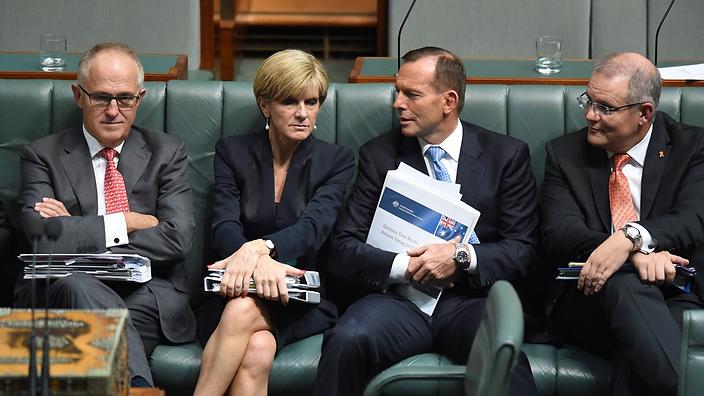
Abbott, Turnbull or Morrison? Who cares? It doesn’t matter.

While a change in leader will most likely give the Coalition a reprieve, it will not automatically produce an amazing functioning government.

Minister for Communications Malcolm Turnbull, Minister for Foreign Affairs, Prime Minister Tony Abbott and Minister for Social Services Scott Morrison during a division at question time in the House of Representatives at Parliament House in Canberra, Thursday, March 19, 2015. (AAP Image/Mick Tsikas) NO ARCHIVING

It feels inevitable. After a disastrous month the vultures are swooping around the dying leadership of Prime Minister Tony Abbott. Over the past week there have been reports the camps of Malcolm Turnbull and Scott Morrison are mobilising and it seems unlikely the issue will go away until there is another spill. Abbott’s leadership is truly in trouble.

But does it really matter? Will a leadership change actually change anything?

I don’t think so.

To start with let’s be realistic and accept that a leadership change will have little to no policy influence.

While some progressives as still pining for a shift to Malcolm Turnbull, wrongfully in my opinion, it is becoming increasingly clear that Scott Morrison has become the front runner to be the next Liberal Leader. That’s right: the Scott Morrison who was the architect of the Coalition’s asylum seeker policy and was recently pushing for a referendum on same-sex marriage in order to make it more difficult for it to pass.

So before you get your hopes up you can forget about legislating same-sex marriage, increased ambition on climate change or a more progressive approach on asylum seekers. And you can also continue to expect attacks on our public services, unions and those on welfare. None of that is going to change.

Yet, much like the leadership turmoil that engulfed Rudd and Gillard the recent turmoil inside the Coalition has nothing to do with policy anyway. While Abbott has been criticised for being a little ‘policy light’, few are actually questioning his philosophical direction. Instead the pressure is focused almost entirely on style — his preference for ‘captain’s picks’, his focus on ‘announceables’ and his lack of consultation. As Jack Waterford of the Canberra Times argues:

“He has to go because he wont stop being Tony Abbott. He cannot or will not change his style. The public, if not the front or back bench, is increasingly angry with him about it.”

Abbott has to go not because his philosophy is bad, but because his Government has become a “shambles”. He has to go because the public have stopped listening, with it now being impossible for him to ever win them back.

But will a leadership change actually create a more effective Government? Will it give the Coalition the authority they need to implement their agenda?

Again, I think not.

To answer this question we need to look at why Abbott, and the Government in general, are struggling so much.

Abbott clearly has his major flaws. He’s made some ridiculous decisions recently, whether the knighting of Prince Philip or defending Bronwyn Bishop to the death. Clearly he is not the greatest of leaders. But the Coalition’s crisis is not just one of leadership, but one of politics itself. Abbott is suffering because the public have lost so much faith in the political class that he has no ability to power through his Government’s flaws as leaders once did.

Just think back to the last enduring federal political leader in Australian history: John Howard. Howard’s Prime Ministership was so lengthy that we often forget his first term was a relative disaster. Howard lost seven Ministers due to political scandals, faced splits in his party over gun legislation and his response to One Nation, and was branded a liar for his reversal on the GST. It was probably enough to destroy a leader in today’s age but despite all this Howard survived. He had enough authority within his party to hold off the threats, and enough authority within the community to win another three elections.

Howard’s feat seems impossible for leaders today. Our society has developed, rightfully, a huge distrust in our politicians. Due to the eroding of their social bases political parties now no longer have the authority to push through this distrust. This leads to politicians constantly battling the last scandal, with each one affirming already held views within the public. Each day becomes a desperate attempt to create some form of authority. Hence Abbott’s ‘announceables’, the focus on national security and attempts to show ‘leadership’ through ignoring the cabinet and back bench.

Don’t believe me? Look back at Australia’s recent political history and you can see trend play out as clearly as day. Since 2007 we have lost seven Government leaders from spills and scandals — Kevin Rudd and Julia Gillard federally, as well as Barry O’Farrell, Nathan Rees, Morris Iemma, Ted Bailiey and Terry Mills at a state level. Another three, Campbell Newman, Kristina Keneally and Denis Napthine have then gone on to lose elections based on similar problems. And that doesn’t even take in to account the opposition leaders — federal and state — who have been thrown away in recent years. Our politics has become one of constant turmoil. Turmoil that is not going to end any time soon.

So, Abbott, Turnbull or Morrison?

It doesn’t matter.

While a change in leader will most likely give the Coalition a reprieve and turn attention back onto Bill Shorten, it will not automatically produce an amazing functioning Government. Australian politics, at least for the time being, has moved beyond that.

Get strapped in for a fun ride.

ByLine, the Fringe, traveling and more

Some of you may have noticed that I haven’t blogged much recently. That’s because it has been a pretty crazy month, and I have just run out of time. So what has been happening? I thought it would be good to do a round up!

ByLine 

The big news is that this week I launched my crowdfunding campaign at ByLine.com for my book, Sexy Capitalism. The crowdfunder is designed to raise me enough funds so I can get properly started on a first draft — something I can send to a publisher.

The campaign is going well so far. At time of writing I have been going for just over two days and am 15% funded, which is really great. But there is still 85% to go! So it would be really great if you could all jump on board!

You can support the campaign here: https://www.byline.com/project/17

The Fringe

Oh my god it is The Fringe! I have been told by so many people that Edinburgh radically changes during The Fringe and people were right. The city has just changed in the last week — the streets are full, things are happening everywhere and it is just much more lively.

The Edinburgh Fringe

I’ve been to five shows so far, not a bad start! On the first night my partner and I went to some bad comedy, but still worth it. In particular we went to a show where comedians commentate C-grade movies. The movie in question was titled “Santa Conquers the Martians” and was much funnier than the comedians themselves, and luckily funny enough that the night was great.

Otherwise we’ve been to a show called Festival of the Spoken Nerd, which was some really great nerdy comedy fun and last night my dad (who is in town) and I went to a Looking Through A Glass Onion — a show about John Lennon. It was really excellent. But the most interesting has probably been Dicing with Dr Death by Dr Philip Nitschke. I wasn’t really sure what it was about, but the show could be best described as a workshop on how to kill yourself if you ever find yourself in that position (no wonder we had to agree to a waiver saying we wouldn’t follow the instructions literally). I have no intention of following any of Nitschke’s instructions, but it is interesting in that it is something I found useful. The show was also really entertaining — Nitschke basically spoke for the entire hour, but he was never boring. Really worth seeing.

Travel travel travel

Of course this all comes after some pretty awesome travel. My partner Martyn and I went on a holiday to Paris and London and had a great time. I have to say Paris did not grab me — it is a beautiful city, but that was the most I could say about it. And all the potential interesting parts — Montmartre in particular had the feeling of having become a tourist attraction about a place that used to be interesting.

But I love London. London has the same tourist issue, but at the same time I feel it is more organic and interesting and different. We stayed with some friends in Peckham which was a really fascinating part of town (anywhere else and being that far out you’d be in the suburbs, but not in London) and we went to some great exhibitions — the Wellcome Collection and the National Library were two big highlights. Also met up with some good friends and everything was great.

And to add to that my dad is now in town and from tomorrow we’re doing a long weekend in the Scottish Highlands. There will be whiskey and beautiful places, so can’t complain. Am looking forward to it!

***

Phew! That’s it for the moment. No wonder I’m a little tired. Maybe time for a nap?

Sex and Capitalism: Part One

Part one of a two part essay investigating how sexual and gender oppression are inherent within capitalism.

simoncopland_mHlmtDh.png.600x600_q85

Originally published in ByLine, 12 August 2015

My thesis is that the history of sexual relations has always been connected with our economic system. More specifically I argue that modern sexual oppression, and how we understand sexual freedom, is inherently linked to capitalism.

So how is this the case, and why is it important? In an essay split over two parts I am going to look at how sexual relations developed via capitalist society, and how this continues to play out today.

In part one I am going to go back in time and look at sexual relations before capitalist society. It is through understanding the history of sexual relations, I argue, that we understand them today.

                                                                           ***

When I first came out as gay at the age of 16 I remember my mum being worried my sexuality would make life more difficult for me. It was a genuine concern, and as a nervous sixteen year old, it was one of the big fears I had as well.

In reality, for me, it has not been the case. Being white, middle class, and from a wealthy city in Australia I’m doing pretty well for myself. I can honestly say that, as far as I’m aware, I’ve never been on the receiving end of any major life-changing discrimination.

This is a sign of great achievement. Of all areas of society, sexual and gender relations have probably seen the greatest shift over the past fifty years. It is easy to forget that at the birth of the second-wave feminist and gay liberation movements in the 60s and 70s women were still largely expected to live their entire lives in the home, while homosexuality remained illegal in most Western countries. Discussion of sex in the public sphere was extremely taboo. Much has certainly changed.

Yet, look a little deeper and at the same time little has changed as well. While gays can increasingly marry, other queers still face significant poverty, discrimination and violence. While some woman are reaching the top of our power structures, the wage gap remains seemingly intractable, violence against women takes lives every day of the week, and restrictions remain on abortion rights in most of the world. The freedoms we have won seem increasingly only available to a few, with the underlying factors of sexual and gender oppression remaining unmoved.

Why is this the case? Is it a matter of us just needing to be patient, or is it because of something much more fundamental? To answer this question we need to look at why sexual oppression occurs in the first place.

There have been many explanations of why sexual and gender oppression exists. Many feminists, for example, argue that male privilege comes down to a biological need for men to dominate, a need they have managed to exploit over different periods of history. For gays and lesbians the answer is often directed at religion and the massive influence it has had on our society.

I argue however that it comes down to something very different — economics.

To understand this we need to look at the most influential sexual institution in our society — the family. From the moment we are born we are all conditioned with values of the nuclear family. We’re told a simple story: you are destined to grow up, meet the boy or girl of your dreams — always of the opposite sex —, fall in love, get married and have children. You will search for this person from the moment you hit puberty and will not give up until you find “the one”.

This is the story of us all entering the modern nuclear family, a relationship that has a range of values imbued in it. The nuclear family allows us to search for one partner and one partner only. That person will remain with us for the rest of our lives, through thick and thin, in sickness and in health. If the relationship ends, as more and more do these days, it is a failure. And of course you will have children, and if you don’t you will be followed around for the rest of your life being asked “when are you going to have children?” or “why didn’t you have children?”

Many see this as the natural way for humans to mate. In fact many scientists have tried to claim that monogamous unions are rooted in our biology. They use evidence such as the supposed ‘low female libido’ or the existence of monogamous unions in one of our close relatives, the gibbon, to back up these claims. The nuclear family, and the patriarchy that comes with it, is as old as society itself.

This story is based in Charles Darwin’s theory of sexual selection. Darwin argued that due to their need to carry and nurture children women have a great investment in their offspring than men. They are therefore much more hesitant to participate in sexual activity, creating a “conflict” between the two genders.

This conflict leads men and women to negotiate what anthropologist Helen Fisher calls the “Sex Contract”. With women producing such “unusually helpless and dependent offspring” they require a mate who can look after both them and their children. Men however are only willing to do this if they can be guaranteed the child is theirs — otherwise they are investing their resources for the genes of another man. In turn men demand fidelity; an assurance their genetic line is being maintained. A contract is formed — resources for fidelity.

In many ways the Sex Contract is exactly how modern relationships have been formed (more on that soon). However, unlike how many of these theorists have suggested it is not actually a ‘natural’ way for humans to get together. Evidence suggests that early hunter gatherer families actually looked very different to this. Many biologists and anthropologists argue early hunter gather societies lived largely in polyamorous relationships where much of the social stratification we see today was non-existent. In fact anthropologists say people in this period practiced “fierce egalitarianism” — that is egalitarianism that is not just a mistake but a thought-out-process. And this was not just for men — women were largely seen to have a high level of authority and power.

That is not to paint a picture of a “nobel savage”. People lived this way primarily as it allowed their communities to survive. Hunter-gather societies existed as small roaming groups where men hunted and women largely gathered. In these societies community was everything — everyone relied on everyone else in order to survive. As Jared Diamond explains, with no ability or need to store or hoard resources, “there can be no kings, no class of social parasites who grow fat on food seized from others”. This was true as well for our sexual relations. As the co-author of Sex at Dawn Christopher Ryan explains, “overlapping, intersecting sexual relationships strengthened group cohesion and could offer a measure of security in an uncertain world.”

So how did the Sex Contract, and the modern family, arise?

The modern family has grown, changed and adapted significantly since our prehistoric origins, but its modern ideals can be found in the birth of agriculture. Hunter gatherer societies did have gender roles — men hunted and women gathered. But this did not mean women had less control. In fact with hunting being a very hit and miss game, women provided the majority of food, and had significant authority and influence in social and family affairs.

Agriculture however changed this. When we began farming humans began to settle down, and in turn start accumulating. With farming we first developed the concept of private property, a notion that changed our society and our sexual relationships dramatically.

Private property did not necessarily change our gender roles, it just changed the value provided to them. Moving from their position as hunters men began to look after the farm, while women largely stayed in the home looking after domestic duties. As resources were now derived solely from the farm, wealth landed in the hands of men. On top of this, as farming required significant increases in labour capacity, women were increasingly forced to stay at home to look after a growing family.

Here we see a major shift in sexual relations. No longer economically independent, and losing much of the community that existed in hunter-gather periods, women became more dependent on men. But men required something in return. Accumulating wealth they now needed someone to pass that wealth on to. In turn men demanded fidelity — the assurance their children were theirs. Here we see the defeat of “mother right” and matrilineal descent. Friedrich Engels described the impact of this:

“The overthrow of mother right was the world historic defeat of the female sex. The man took command in the home also; the woman was degraded and reduced to servitude; she became the slave of his lust and a mere instrument for the production of children. . . . In order to make certain of the wife’s fidelity and therefore the paternity of his children, she is delivered over unconditionally into the power of the husband; if he kills her, he is only exercising his rights.”

Hence we can see how the rise of agriculture and the class society brought much of our sexual oppression with it. Agriculture, and the idea of private property that came with it, led to the development of the patriarchy, and the loss of much of the sexual freedom that existed in hunter-gather societies. It created our first social stratification.

But this is just the beginning. These changes took hundreds of years but were probably some of the most significant in human history. But it is not the entire story we have to tell.

What happens next is what we’ll explore in part two of this essay.

ByLine Campaign: Why do a crowdfunder?

Today I launched a campaign with the team at ByLine.com to do a crowdfunder for Sexy Capitalism. I thought this would be a good opportunity to talk about why I decided to do this campaign.

First, before we get started, you can support my campaign here.

Power of Words

Let’s skip quickly through the obvious financial reasons for crowdfunding a book. I’ve been working as a freelance writer full time for just under a year now and, while I am doing pretty well, writing doesn’t pay very well. I spend a lot of my time pitching to get work, or writing about stuff that doesn’t particularly inspire me in order to get paid. The stuff I want to do — write Sexy Capitalism or work on my novel — is often the stuff that doesn’t pay. This is all particularly true given the troubles we’ve seen both in journalism and the publishing industry — getting paid to writer is harder than every before.

Crowdfunding, for me, was therefore a good alternative. It provides a great way to get the funds I need to work on my book. But, while really important, in some ways the funds are secondary. My primary reason for launching a fundraiser is more about engaging you with my work. 

One of the things about writing is that it is very solitary. I spend most of my days sitting at home in front of a computer, with most of my social interaction coming from social media or the brief chats I have with the people who serve me coffee.

Often this makes me feel quite isolated, and I end up striving for social contact. I actually, at times, miss working in an office and having people right next to me who I can talk to.

More than that though I’ve realised it is a little intellectually draining. My work benefits most when I am getting feedback on my ideas and even more importantly when people challenging me on my ideas and assumptions. Yet, freelance writing is not designed to do that — particularly in the world where editors and publishers are skint for time and therefore struggle to provide in-depth feedback.

What I am hoping is that this campaign will provide some of that space. I want this to be an opportunity for you to join me as I write this book, so that instead of me being chained to my desk and never talking to anyone, the writing becomes a collective process. I am not the only one out there with these ideas, and so why not open up the doors and let everyone be part of the process?

This is where ByLine is great. The ByLine platform has a Supporters Cafe where anyone who makes a donation is able to log in and we can chat as much as you want. I am also intending to write a serious of columns linked with the campaign (first to go up soon!) to give you all a sense of where my thoughts are going with the book. I hope this provides a chance for people to tell me where they think I’m going right, and where I’m going wrong.

I want, in a way, not just to crowd source my funds for the book, but to crowd source the ideas as well. I think that will make for a better book in the long run.

So that’s why I’ve teamed up with ByLine.

I hope you can all support it and help me make this book a reality!

You can support the campaign here: https://www.byline.com/project/17

Calais ‘crisis’ a product of the failures of our political class

The situation in the northern French port of Calais has hit the headlines in the past week – and we should reflect on the political language employed, and its similarities to Australia.

A migrant jumps a fence as he attempts to access the Channel Tunnel in Calais, northern France, Wednesday, Aug. 5, 2015. Thousands of migrants have been scaling fences near the Channel Tunnel linking the two countries and boarding freight trains or trucks destined for Britain. (AP Photo/Emilio Morenatti)

Originally published in SBS News, 6 August, 2015

Last week, I had the privilege of traveling through the Channel Tunnel on my way to London. My trip occurred under the backdrop of the so-called “migrant crisis” that has engulfed the French town of Calais — a “flood” of asylum seekers trying to migrate to the UK in the darkness of the tunnel.

The crisis has engulfed UK politics over the past couple of weeks. Prime Minister David Cameron has made the issue a top priority, increasing protection at the border with fences and dogs, and even releasing new legislation that will force landlords to evict immigrants who are not in the country legally. The Conservatives have done their best to make immigration an issue, being accused of dehumanising asylum seekers in the process.

Moving to the UK about six months ago I arrived with a particular perception of Australia’s immigration politics. Like many others I saw Australia as a weird anomaly — an extreme government going against the standards of the world. We hear this a lot. Australians hate asylum seekers; a hatred that has arisen due to a unique racist history (largely based in White Australia Policy). Many even felt vindicated when the leader of UK Independence Party, known for their anti-immigration policies, said even he wouldn’t go as far as Tony Abbott with his immigration policies. Look how bad we are!

Living in Europe though I realised that Australia is not alone. The Calais crisis comes after months of discussion about the Mediterranean immigration crisis that has engulfed Europe. Over recent months tens of thousands of immigrants have fled northern Africa, with thousands of them drowning on the way. The response has been eerily similar to that back at home —  the demonisation of those fleeing war torn countries, a refusal to increase settlement numbers, cuts to search-and-rescue services, and even proposals to use the military to seize and destroy boats used for transporting asylum seekers. Watching the debate has transported me straight back to Australia.

But in doing so, it has highlighted a valuable lesson. When it comes to immigration, everywhere in the world is largely the same. The debates, excuses and demonisation — all largely the same. While this may sound depressing it is actually an important lesson to learn. Because in seeing how the debate transpires globally you can start to see the real cause of the deep crevasse we’ve found ourselves in.

In making our asylum debate some unique problem for Australia we have, inadvertently missed the reality of why we’re treating asylum seekers so poorly. For years we have primarily blamed the debate on an inherent racism in our society that our politicians have worked to exploit. Reacting to this, immigration advocates haveframed our response through the lens of “human rights”. We work hard to humanise those trying to reach our shores, arguing our treatment of them is denying the very rights we all deserve.

In many ways this humanisation has worked. The SBS show Go Back to Where You Came From caused global headlines, our newspapers regularly contain hard-hitting pieces of those suffering on and off our shores, andsupport often floods to those battling the system. Despite all of this, our policies continue. Why? Look at the global perspective and you can quickly see its because the frames we use are on the periphery of the debate. While racism is clearly a factor, it certainly is not the leading cause.

So what is the cause? Tad Tietze argues that when you look at the global history of immigration politics you can find a common thread — economics. In times of economic growth governments welcome immigrants, whether coming “legally” or “illegally”, with open arms. Immigrants are needed to fill the increasing numbers of jobs, so we let whoever we can in.

On the flip side though, when things get tough, governments start to crack down — at least to some groups. Immigrations levels tend to stay high as immigrants are still needed for the economy to survive. However, governments crack down on a particular part of the immigration equation — in modern cases that is asylum seekers. Asylum seekers are used as scapegoats, a deflection away from the real causes of our problems.

This is why we hear so much about asylum seekers ‘stealing our jobs’, or attacks of them being ‘economic refugees’ instead of real refugees. In times of economic trouble immigrants are used as a way to stop us from turning towards the bankers, business owners, employers, and the politicians who have caused the problems. It is here how you can understand the growth of anti-immigrant ideals since the 2008 economic crisis — from Scandinavia to Greece, the UK to Australia. A crisis caused by the banking system has seen banks get massive bail outs, while immigrants have faced increased restrictions on their right of free movement.

But in many ways this is now moving beyond economics. Over recent decades we have seen a major eroding in the trust of our political class — what many are calling a rise in ‘anti-politics’. Politicians are losing authority by the day, and as they do so they turn more and more towards external scape goats. Hence the domination of the asylum in Australia for decades in now. It is a way for our political class to shift away from their failures and try to rebuild authority in doing so.

This is the lesson we can learn from Calais. The asylum debate is not due to some inherent evil within the Australia system. It is not due to our inherent racism, or even the failures of any individual politician or political party. Our asylum debate is about political economy — the use of innocent people as scapegoats for the increasing failures of our political class.

While campaigns around human rights and international law therefore must continue, we can, and will, only change the debate when we look at the global cause of the problem. That cause is political, and economic. It is the nature of our capitalist system. Until we understand that we will remain in this awful stalemate for a very long time.

This article was originally published on SBS News. Click here to view the original. © All rights reserved.

What the ‘Ashley Madison’ hack reveals about our relationships

We may be quick to demonise those who use Ashley Madison, but we really should be asking why the site is so popular. 

ashley-madison-768x512

Originally published in Junkee.com, 27 July 2015

If you’ve ever used the website Ashley Madison, it’s likely you’ve spent the past week shitting yourself.

The online “dating service”, which boasts the tagline “life is short, have an affair”, was infiltrated last week by hackers, who demanded Ashley Madison shut down the website permanently, or suffer the release of “all customer records, including profiles with all the customers’ secret sexual fantasies and matching credit card transactions, real names and addresses, and employee documents and emails.”

There has been a lot of debate about the ethics of Ashley Madison since this hack was announced. A lot of the response in comment sections and forums has been one of vindication: “Good on the hackers! Cheaters deserve to be exposed.” But, does exposing people really help? Wouldn’t we be better off asking why this website exists in the first place?

Reading about Ashley Madison, I was stunned to learn how popular it is. The site has a total of 37 million members, making it the 18th most popular adult website globally. That’s a lot of people putting their relationships on the line for an illicit affair. Why?

Some answers can be found amongst its users. In an opinion piece in The Guardian, an anonymous writer told of why they joined the site after many years married to their high school sweetheart:

“As time passed, I reflected on my limited experiences in light of the realisation that I may spend the rest of my life fundamentally unsatisfied. I realised that the love I have for my wife is and has always been far more platonic than romantic. I had married out of convenience and safety with little regard for anything deeper, other than the avoidance of any kind of insecurity, pain, or challenge. We really have had a comfortable life, but I reached a point where I was ready to act on my long-repressed desires and impulses, to broaden my horizons, even if it meant risking that life in search of what it meant to actually live.”

You’ve likely heard this story before: A man goes through a ‘mid-life crisis’, so desperate for a thrill he’ll put everything on the line; the horrible cheater who surely deserves as much pain and humiliation as possible. But look at the numbers, and these stories are more common than we may like to admit. The data varies between studies — the phenomenon is a particularly hard one to measure — but research suggests that between one in five and one in four people have cheated at some point in their life.

To me, honesty is a key part of a relationship; I have a problem with people having dishonest affairs. But is it really the case that cheaters are just inherently bad? Or is there another reason behind our cheating epidemic?

What Even Is Cheating?

It may seem obvious, but when we look back at history the question of what constitutes infidelity gets a little blurry.

When I first went to write this article, my immediate thought was that Ashley Madison was a symbol of increasing infidelity rates; the numbers above are pretty high, you have to admit. But then I realised there was no way to substantiate that claim. What has certainly changed, however, is our approach to infidelity — or more importantly, our approach to love and sex.

As I’ve written about in the past, prior to the Victorian era marriage was solely an economic institution. We did not pair together for love; we paired together to survive. In doing so, infidelity — or sleeping around — was viewed very differently than it is today. Particularly for men, but even for women, infidelity was in many instances totally acceptable. As Hunter Oatman-Stanford writes in Collector Weekly, the French aristocracy used to believe “that true romantic love was only possible in an adulterous relationship, because marriage was a political, economic, and mercenary event. True love could only exist without it.”

This all changed in the Victorian era and with the rise of industrial capitalism, as the working class in particular began to marry for love instead of economics. This brought with it a whole range of new social norms — from the romanticised notion of love being about a monogamous life-long commitment, to women facing the “cult of the domestic”, or the idea they had to submit entirely to their men, both domestically and sexually.

In the past 200 years our perceptions of sex and infidelity have changed significantly. Does this excuse cheaters? Not necessarily. But it may go some way to explaining why rates of cheating remain so high.

The Pros Of Polygamy 

Earlier this year, I wrote about my multiple dating and sex lives. I wrote about my relationships with my two boyfriends, James and Martyn. Some of the comments I received were similar to those I see targeted at “cheaters”. Some treated me with an air of disgust, as if I was inherently hurting James, my first boyfriend, by seeing someone else.

Yet to me, my relationships — and the relationships of those who are in similar situations — reflect inherent problems with our modern norms. They present a potential solution to the cheating epidemic we seem to have found ourselves in.

James and I started an open relationship through a basic understanding that we could have sex with someone else and still love each other. But it also went much deeper than that. We realised that we cannot, and should not, be expected to provide 100% of each other’s sexual or emotional needs. James, nor Martyn, can give me everything I want in a partner, and it is completely okay to say that out loud.

I think we all understand this in some way or another. Even when we pair up monogamously, we stay close with friends, family and colleagues. We keep our hobbies and work friends and sometimes even travel separately. This proves we need more than just the companionship of our chosen mate.

Yet when it comes to romantic love, and sex in particular, we throw that understanding out the window. Pair up with someone, and that is the one and only person you will have sex with, or date, for the rest of your life. That is where you are stuck — and if by any chance there are areas where you are not satisfied, or even if there’s just something you want to explore more, tough luck. That is the price of love.

To me, these standards are the reason a site like Ashley Madison has become so popular. It is easy to say relationships that involve cheating are just inherently bad; that people are marrying the wrong people, that technology is making romance more difficult, or that our romantic standards have become too high. But I think infidelity often comes down to something else: while some can spend their lives being happily faithful to their one partner, for many, our relationship norms just don’t make sense. By their very nature, norms force individuals into them even if they don’t quite fit. When we measure success in such a limited way, it’s no wonder so many relationships fail.

It’s A Matter Of Honesty

One of the key tenets of my relationships with James and Martyn is honesty; it’s the dishonest forms of cheating that cause a lot of pain. And this is where I find Ashley Madison so problematic.

The issue I have with Ashley Madison is not that it encourages people to have sex outside their marriage, but that it reinforces the most problematic aspects of relationship norms while it profits from them. Part of Ashley Madison’s appeal is the sexiness of doing something wrong. The site itself is littered with references to “cheating partners” and “discreet encounters”; the front page has a picture of a woman with a finger over her mouth, indicating secrecy. The whole affair is designed to be sexy in a naughty way.

We should be able to achieve this feeling without dishonesty, but Ashley Madison doesn’t present that as an option. A better site, to me, would be one which challenged our social norms, encouraging those who don’t want a monogamous union to be open and honest about it, at least with their partner. That in itself could be extremely sexy (you can trust me on that), and has the benefit of not hurting people in the process.

The Ashley Madison hack is a huge and disgraceful breach of privacy, no matter how we feel about those who were using the service. But shutting down the site, as the hackers propose, is not the answer either. Instead we need to ask why so many people are using it. By looking at the real reasons behind infidelity, we might be able to find new solutions to dishonesty — ones that don’t lock people out from getting what they want.
Read more at http://junkee.com/ashley-madison-hack-cheating-spouses-2/62113#Hf9JThSWL2LJrpFo.99