Labor victory coal comfort for electorate if major projects surge ahead

The ball is in the ALP’s court when it comes to Queensland’s coal policy.

Last weekend saw a huge moment in Australian politics. After being reduced to a rump in the 2012 election the ALP finalised their triumphant return to Queensland Government.

On the other side of the world there was another momentous occasion. In line with Global Divestment Day, the three major parties of the United Kingdom (the Conservatives, Labour and the Liberal Democrats) signed a joint pledge to to phase out coal use.

These two moments may seem thousands of kilometres apart, but happening on the same weekend, they are in fact extremely close.

While the UK was pledging to phase out coal, the Queensland Government already started to face pressure over major coal projects in the state. As quickly as their election was declared Federal Environment Minister Greg Hunt stated he was holding off on approvals for two large coal developments — the new Acland Coal Mine and the Abbot Point Coal Terminal. The two projects have both been extremely controversial (for different reasons) and Hunt’s position immediately places pressure on the ALP Government to act soon. The question is, what will they do?

So far the ALP has made some right noises over these projects. After it was revealed the company behind the Acland Coal Mine donated hundreds of thousands of dollars to the LNP the new Government promised to scrutinise the process that led to its approval. Up north and the ALP has vowed to remove all Government financial support for the Abbot Point Development. These moves are likely to delay the construction of these two projects, putting their development into further doubt.

Yet, while these moves are good, it is time for the ALP to go further.

For years now the ALP have heralded themselves as the champions of our climate, and more recently of our Great Barrier Reef. In passing a carbon price in federal Parliament the party positioned itself as the only party acting on the science of the issue, calling the LNP deniers and climate vandals. We saw this play out in Queensland, in particular around the Reef. The ALP ran hard on Reef issues, with the issue seen to have played a large role in their winning numerous inner city Brisbane seats.

Yet, when it comes to the crunch, the ALP still supports the construction of these projects. If seen through their policies will at best delay construction, with the impacts on the Reef and climate still being felt.

The time for that support has to come to an end. As climate change continues to accelerate the ALP can no longer claim to respect the science while continuing to dig up coal. Delays are no longer good enough. If the party is serious about protecting the climate and the reef it will seriously look at ending the mining and export of this commodity for real.

Around the world global leaders are taking up this challenge. On top of the UK commitment in recent years we’ve seen China place a cap on coal usage, while India has increased taxes on coal mined or imported into the country. In the United States President Barack Obama has placed restrictions on pollution from coal fired power plants and looks likely to soon reject the Keystone XL Pipeline, a significant shift away from the fossil fuel industry.

The Queensland ALP has the opportunity to join this global trend. Moving on their election platform straight away would be a good start. But the party needs to do more. The Abbot Point Coal Terminal and Acland Coal mine, along with other coal projects in the state, should simply not be built. They are not good for our economy, our Reef and more importantly our climate.

The opportunity is there. It’s time for the ALP to finally take it.

This article was originally published on SBS News. Click here to view the original. © All rights reserved.

Is really good sex what actually happens at a sex festival? I went to find out

Originally published in The Guardian, 5 February, 2015

When I told my friends and colleagues I was going to a festival of sex, they were quick to jump to salacious fantasies. Most assumed I was going to a mass orgy – a weekend of rampant debauchery. Others had visions of Sexpo – strippers, pole dancers and porn stars. Me? I had no idea. Yet as I arrived at the inaugural Sydney festival of Really Good Sex, I realised this was going to be like nothing I’d experienced before.

The whole scene was just like a normal Saturday morning in picturesque Rushcutters Bay, but as the time clicked closer to 9:30am, the anxiety built inside me. The venue became crowded as the 150 or so participants began to arrive. Young, old, male, female, big, small and in between – a real mix of people. I watched them all, wondering who they were and why they had come.

The festival comprised of a series of workshops. Some were theoretical discussions of sexual topics, while others were more physical — an opportunity to explore and practise sexual techniques. It was the latter that I was both most interested in and anxious to explore.

I started with what I thought would be an easy entry. My first session was called “Hold me tight” – essentially an exploration of hugging. It began with the instructors – two sex practitioners who had travelled from Germany and Austria – talking about the value of holding in sexual play. It’s something we do so often, yet rarely think about. Then it was time to put it into practice.

The session required us to experiment with holding people in different places, showing resistance to being held, “crushing” your partner and finding their limits. Before I knew it I was entangled in deeply sexual embraces with people (mostly women) who I had never met.

In the final exercise, we practised holding each other while lying down. I was paired with a woman and for a few minutes we rolled around on the floor playfully trying to get on top of the other. It was like the play-fighting I often engage in during foreplay. It was both sexual and nonsexual, intense and yet so easy, enjoyable and also confronting.

Participants at a workshop in the Sydney Really Good sex festival. Facebook Twitter Pinterest expand
Participants at a workshop in the Sydney festival of Really Good Sex. Photograph: Tyler Saunders/The Guardian.
Next I went to a session titled “A radically inclusive approach to really good sex”. To boil it down, this workshop was based on the idea that if you let go of some of your prejudices about who you are attracted to, then maybe you could explore new, inclusive, and enjoyable experiences of sex. And what better way than to practise?

Advertisement

At the end of the session we were paired with a partner we didn’t know, told to strip down to a level of clothing we felt comfortable with (my partner and I both stripped to our underwear) and then to touch each other for five minutes. I focused on touching my partner’s arms, chest and head, while he took a full-body approach, starting at my legs before working his away across my torso, arms and head. I was able to experience joy in exploring the bodies of people I probably wouldn’t have glanced at in a different scenario.

Other sessions I attended were more theoretical, including the “Mono versus poly” debate where about 30 people discussed the challenges of different types of relationship structures.

In another session, titled “A journey into vulnerability”, we explored the parts of ourselves we are uncomfortable with and tried to bring those into the fore. We did this by answering questions that may be considered difficult (ie what sort of sex would you like to explore more, or what was the most difficult moment in your life?), challenging us to publicly express ourselves.

On Saturday night we were treated to performances with acts with titles like “Orgasmic solo intimacy” and “Feasting the body”.

By Sunday I was feeling more adventurous and ready to give anything a shot. I started with “Loving play with rope”, but it wasn’t until the session titled “Interrogation play” that I started to really realise the value of the weekend. The session started with us by splitting into two groups. Everyone got to take turns interrogating the others with the basic question: “Who are you?” The idea was to explore how power play, even when it is “nonsexual”, can be a strong part of sexual play.

Before I knew it, I was standing over my subjects and screaming at them, abusing them, demanding they provide answers to questions I had just made up. With one partner we made up a scenario where I was interrogating her over expensive art she had stolen. I stood over her demanding she tell me where the art was or face severe consequences. I became very aggressive and was turned on by the whole experience. Within a few minutes I had discovered a part of my sexuality, and my personality, I hardly knew I had.

It got even deeper in “Objects for sex play”. Here our facilitator asked us two simple questions: “What body part do you use most during sex” and “What object do you enjoy using the most during sex?” It took me a moment, but I finally answered with “my brain” and “a blindfold”. A moment later I realised the connection. I can get anxious during sex, overthinking things in a desire to control the situation. This is a bit like my life in general – I am an anxious overthinker. A blindfold takes that away, however. The moment I lose power my anxiety goes as well – I am no longer able to control things and therefore have nothing to get anxious about anymore. Maybe that’s why I got so aggressive during my interrogation – it was the loss of control that turned me on.

If sex is metaphor then this was the perfect one for my life. Just as I have a desire to let go in sex, I realised, I have the need in life. One I still haven’t fully appreciated. In a moment of play I discovered something very deep about myself.

That was the thing about this festival. Sex is such a strong part of our lives, yet we have so little space to actually explore it. We contain it to our bedroom, rarely spreading out beyond those four walls. And that’s a problem. I think Janet Hardy, keynote speaker and internationally renowned sex educator, explained this best. In an interview with her, she said: “You just can’t say ‘sex is here’ and ‘the rest of your life is here’. You breathe sex in, you exhale it, it goes in through your pores and you sweat it back out.”

At the festival it didn’t matter who people were, what their gender, size, age or even sexuality was. I played with people young, old, queer, straight and of all different genders. And I didn’t care. Each new person was just another opportunity for exploration. Another opportunity to find out more about myself. While that sounds confronting and weird, there was something exciting and empowering about it.

That’s the contradiction I was feeling on the first day. The whole weekend felt strange because we tell ourselves talking about sex has to be strange. Yet it felt everyday because that’s where it should be — sex is of the everyday.

Sex is such an integral part of our lives, yet for some reason we think we have to hide it away, learn about it completely on our own and never broach the topic if something goes wrong. To me that seems far more strange than going to a festival of really good sex.

The great leadership myth

A series of ‘leaderslides’ have carved up the Australian political landscape, and it’s time for the practice to stop.

It has been a bad week for Australian political leaders.

In one week, Queensland Premier Campbell Newman has lost his job, Northern Territory Chief Minister Adam Giles has fended off an attempted coup and Prime Minister Tony Abbott has seen his political future slip out from underneath him.

What is going on? Australia has become a nation of ‘leaderside’. We dispose of leaders almost as quickly as they rise to power, quickly blaming them for anything that goes wrong with a government. Kevin Rudd and Campbell Newman were too arrogant and Julia Gillard and Tony Abbott simply had no political intelligence. Yet the real problem doesn’t lie with individual leaders but with our concept of leadership itself.

Over the past decade our society has entered what some call a ‘crisis of politics’. As the social bases of our major political parties have been decimated, so has their authority within society. Politicians have become heavily distrusted, with assumptions they are all deceitful and only in it for their own power. Those who run against the political establishment are quick to gain popularity. Nowhere is this trend greater it seems than in the way we treat political leaders.

A bit of context here. Over the past decades our society has become more obsessed with ‘leaders’. Connected to our neoliberal focus on the individual, we have placed more faith in ‘leaders’ to provide solutions for our social and political problems. Gary Gemmill and Judith Oakley call this our ‘great leadership myth’ — the idea that our organisations, institutions, and broader society, require great leaders to survive. Without a leader we are helpless.

Nowhere can we see this more than in our politics. Over the past few decades, Australia has trended more towards a ‘presidential’ style of politics — one where the focus is placed heavily on the leader of a party instead of on their politics or policies. We focus our attention almost solely on our party leaders, giving them unprecedented power.

The problem with this, as Gemmill and Oakley argue, is that it de-skills and de-mobilises those around leaders — from their political colleagues to the mass population. This is why we see constant complaints from backbenchers that party leaders are not consultative enough. The leadership myth removes power from the masses and to provides it to an elite few.

Herein lies the crux of why we seem to be facing a new leadership crisis every few months.

As leaders have been given more power they have also become more disconnected from those around them(and importantly from the general population). Look at what is causing Abbott’s leadership woes — concerns he has completely lost touch with the general population and that he is not consultative enough with his party. In the past leaders used to be able to get away with this disconnection as they had a strong social base to back them up. But as these social bases have been hollowed out and the crisis in politics has begun it has become clearer who these leaders represent. Hence we’ve lost our patience — disposing of leaders as quickly as possible.

And herein lies the final contradiction.

Even while the realities of who our leaders represent have become more apparent, the leadership myth has still remained dominant. As our politics trudges through its crisis we have continued to search for a new leader who can save it.

As these crises intensify however we should be heading in a different direction. Around the country, political parties are tearing themselves apart and instead of hoping that the next person may save them, we should be looking at alternatives. This can mean looking at more cooperative forms of democratic decision making, to removing our obsession with party leaders to instead focus on the team of players. It means recognising that leaders are simply a figurehead and that in fact real change comes from all of us.

There can be no doubt that people are sick of the constant speculation and fighting about leadership within our major political parties. But the solutions often provided wont actually deal with this issue. The focus remains on the issue of leadership itself, when it is other alternatives we should be exploring.

In placing all our faith in leaders – in buying into the myth – we have removed ourselves from ownership in our political process. We have allowed others – those with vested interest in the elite – to make decisions for us, and with the expected consequences. It is essential that we start doing that experimentation – getting rid of our focus on leaders and looking to other forms of political organising.

This article was originally published on SBS News. Click here to view the original. © All rights reserved.

The Pope has missed the point on contraception

Telling people ‘not to breed’ is not good enough.

Pope Francis is at it again. The often straightforward Pope this week took aim at family planning practices within the church, stating:

“Some think, excuse me if I use the word, that in order to be good Catholics, we have to breed like rabbits – but no.”

With the imagery of the Monty Python song “Every Sperm is Sacred”, intervention on family planning issues is certainly welcome. Pope Francis has explicitly given Catholics license to be more proactive around the issue, challenging many conservative ideals of the need for a large family.

Look a little closer, however, and it is all smoke and mirrors. While the Pope is talking strong on family planning, the practices and policies of the church are still not changing at all.

To get an understanding of this, it’s best to look at the reason for the Pope’s comments. Francis made his remarks after a visit to the Philippines, where the Catholic Church has been fighting Government legislation that provides easy access to birth control methods. The bill mandates Government health centres to distribute free condoms and contraceptive pills, and was challenged in a Supreme Court Battle at the start of last year. On his visit, Pope Francis backed the local Church in their fight.

The Pope has therefore continued to oppose some of the most effective methods available for proper family planning. The Church still argues the best form of family planning is ‘natural contraception’ — or in other words abstinence. People should just stop having sex, in particular during a woman’s ovulation period.

It would be funny if it weren’t so dangerous.

The use of contraception has been well noted as an effective form of family planning. While not a sole solution, contraceptions can play a role in providing women in particular agency over their sexual choices.

Worse however, lack of access to contraception has strong connections to the spread of HIV/AIDs. Research out of South Africa, for example, has shown that increasing use of condoms has been the major cause in the drop in HIV infections. Research from 2012 showed the level of new HIV infections had dropped in the country by half since 1999. The research directly connected the drop with increasing condom usage.

Interestingly the research also said that many of the reasons for the lack of condom use in the country was cultural. Black South Africans in particular, who represented the largest percentage of infections in the country,had strong cultural disconnections with condom use. As that culture changed, so HIV infection rates went down.

This is where the Catholic Church comes into play. Through much of Africa and Asia the Catholic Church has played a major role in challenging contraception use. The Philippines for example has seen a strong culture of opposition to the use of condoms and other contraceptives, which many have warned could result in the spread of HIV/AIDS. The country is now 8th in the world for infections with the illness.

This is the unfortunate reality for the Pope. Since his appoint Francis has done all he can to position himself as the Pope for the poor. He has taken on massive issues such as economic inequality, climate change and even relations between The United States and Cuba. But in the here and now, no issue is bigger for many poorer countries, particularly in Africa and Asia, than the HIV/AIDS epidemic. The disease continues to rip the heart out of places, decimating an entire generation and leaving those behind far worse off.

In his comments the Pope raised concern the beliefs within the Church around family planning are hurting people’s health, and in turn the broader community. In doing so he showed a willingness to challenge the Church’s practices in order to look after its parishioners. I wonder why this doesn’t extend to people with HIV/AIDS? Telling people ‘not to breed’ is not good enough. If the Pope wants to be serious about family planning, and the health of his parishioners, he will look at challenging the Church’s position on contraception. Until that happens, his rhetoric is just empty words.

This article was originally published on SBS News. Click here to view the original. © All rights reserved.

Leelah Alcorn is the victim of a movement who ignored her

Trans* people face some of the worst discrimination of any group in our society, but they’re being let down by the LGTB movement.

“The life I would’ve lived isn’t worth living in … because I’m transgender.”

These were the words of Leelah Alcorn, who after posting a suicide note on her Tumblr, walked in front of a speeding truck in late 2014.

Alcorn’s suicide has triggered immense grief and anger. People in particular have directed rage at her parents, who refused to acknowledge her gender identity, and forced her to go to a Christian conversion camp. Noted sex columnist Dan Savage came out hard, stating her parents “threw her in front of that truck” and that “charges should be brought” against them.

This rage however seems extremely shallow. While leading figures such as Savage, who has in the past been accused of transphobia himself, have spoken out about Alcorn’s death, transphobia is still largely ignored by the mainstream gay and lesbian movement. While trans* people are always placed within the LGBT rainbow,their issues are normally placed at the bottom of the pile.

Transphobia is still rife within our society. Trans* people face discrimination in their every day life — fromlegislative discrimination and the denial of medical treatment to discrimination in the workplace and violence on the streets. Trans* people have extremely high suicide rates and face murders on a regular basis. Discrimination leads to high unemployment rates and in turn high levels of poverty. Trans* people are at the forefront of discrimination within our society.

Despite this, since the early days of the queer movement, where trans* people led the charge at the Stonewall Riots, they have in many ways been pushed aside. Holding much of the wealth and influence, gay and lesbian campaigners have been able to focus attention on issues that are paramount to them. In particular, recent decades have seen a focus on same-sex marriage — a campaign that has taken huge amounts of resources and attention, but does little to solve transphobic violence and discrimination.

Even worse, trans* people are often shafted when it suits gay and lesbian campaigners. In the United States for example, mainstream organisations actively excluded trans* people from negotiations around the Employment Non-Discrimination Act in 2007. Groups advocated the removal of a reference to trans* people in the bill, believing it would make it more likely to pass. Closer to home, moves to legislate same-sex marriage at a state level led to trans* people being actively excluded from the legislation. Again this was an opportunistic move to get legislation passed. When it comes to the crunch, trans* people are always the first to be discarded by the mainstream gay and lesbian movement.

Of course there are a plethora of organisations who are working on trans* issues. Groups around the world are tackling discrimination, campaigning for trans* rights, and are providing support for trans* people who are having mental health issues or are in need of accommodation, work or healthcare. Each year the InternationalTransgender Day of Remembrance solidifies the call to fight against violence against trans* people.

But these groups largely sit at the margins, with trans* advocates told by mainstream organisations they need to wait their turn for progress. Gay and lesbian campaigners argue trans* people need to wait so we can fight the winnable battles first. It is only after we achieve steps such as same-sex marriage that we will be able to move on to the harder issue of transphobic discrimination and violence.

I wonder whether anyone had the courtesy of explaining that to Leelah Alcorn?

The reality is that while gay and lesbian activists focus on issues such as marriage, trans* people continue to die in our streets. This is the real story of Leelah Alcorn. She was not just denied her rights by her family and society, she was ignored by a movement that purports to stand up for her. She was the victim of being part of a community that pushed her aside. A victim of having no one to stand up for her.

In her suicide note, Alcorn stated:

“The only way I will rest in peace is if one day transgender people aren’t treated the way I  was, they’re treated like humans, with valid feelings and human rights. Gender needs to be taught about in schools, the earlier the better. My death needs to mean something. My death needs to be counted in the number of transgender people who commit suicide this year. I want someone to look at that number and say ‘that’s f***ed up’ and fix it. Fix society. Please.”

It is good that many in the LGBT community have heard Leelah’s call. It is good that this tragedy has made us look deeper into the issues facing trans* people. But unless this is followed with a major shift in focus from the LGBT movement this attention will just look like opportunism. It will look like a way to make noise about trans* rights while not actually doing any of the hard work to tackle the causes of transphobia.

Leelah Alcorn was a victim of our transphobic society. But she was also a victim of a movement who has ignored her for too long.

This is no longer acceptable.

This article was originally published on SBS News. Click here to view the original. © All rights reserved.

Porn restrictions an attack on the power of women

Last week, the British Parliament quietly banned a whole lot of porn. New legislation now forbids a range of sexual acts in porn produced and distributed in the UK – from spanking and aggressive whipping, to face-sitting and even female ejaculation.

While legislators have framed the bill as a way to “protect minors”, many have rightfully attacked it as a form of censorship, in particular targeting female pleasure. The inclusion of female ejaculation on the list has made this case extremely clear. How, one asks, is it okay for men to have the pleasure of ejaculating, while women are denied the enjoyment? And how exactly does a woman ejaculating harm children?

Look more closely at this list however — along with the very similar list that exists in Australia — and the legislation becomes much more insidious. This is not just about denying women’s right to pleasure, but about denying their right to power.

“With this legislation, the UK is in danger of finding itself back in an age where porn is simply the boring, unrealistic, male fantasy of bimbos eagerly pleasing men as if it is their duty, where women are submissive and lack ownership of their sexuality.”

The banning of face-sitting is a perfect example. Face sitting is the act of one partner, often fully clothed, literally sitting on the face of another. It is often practiced, particularly in porn, by dominant females, or dominatrixes. As Itziar Bilbao Urrutia, a dominatrix who produces feminist porn describes: “its power is symbolic: woman on top, unattainable.”

These dynamics run throughout the sexual acts in the banned list. Spanking, caning, aggressive whipping, physical restraint and humiliation for example are all increasingly being used by dominant female performers to show their power over their male counterparts. Boutique and feminist porn production houses, which are growing in size and popularity, are increasingly using these acts to portray strong and powerful sexual women.

It is no wonder therefore that legislators have moved to ban these activities. In engaging in these acts, particularly in a public way, women are challenging a power system that has underpinned our society for centuries. Our capitalist society is based on a system of male domination over women. As men took control economically, they also did so domestically, subjugating women physically, economically and sexually.

While much of this subjugation has been challenged by feminist movements this culture and system is still dominant. One only needs to look at the ongoing horrific levels of sexual and domestic violence men perpetrate against women to see this. This violence is the horrific symbol of a culture of domination — a culture in which men are taught they have the right to control women sexually and physically however they please. A culture in which women are taught they must submit themselves to this dominance.

This is why the claim this legislation is about “protecting minors” is almost laughable. In banning these activities, this bill leaves porn to a mainstream depiction of male sexual domination. Award winning erotic film director, Erika Lust discusses the impact this bill will have on British porn:

“With this legislation, the UK is in danger of finding itself back in an age where porn is simply the boring, unrealistic, male fantasy of bimbos eagerly pleasing men as if it is their duty, where women are submissive and lack ownership of their sexuality.”

Mainstream pornography is designed to please men. It follows a basic formula: a women gives a man a blowjob, he fucks her and then he cums on her face. It is part of a culture that teaches men they have the right to pleasure whenever and however they want, and that it is the duty of women to provide that pleasure, no questions asked. And with children accessing porn at earlier ages, and often learning about sex directly through viewing porn, this is the culture they are being brought up in.

Instead of protecting children therefore this legislation actively harms them. It bans the porn that is challenging this system of domination, actively excluding alternative sexual practices and power systems from mainstream consciousness. In doing so it helps entrench a system of male domination, one that sees girls and women fall subject to physical and sexual violence on a daily basis.

Porn bans in the United Kingdom, and Australia, are not there to protect children. They are misogynistic attacks. They teach a standard of sex and sexuality that denies female pleasure and more importantly denies female power. These bans are not about protecting children, they are about oppressing women. The consequences will be real.

This article was originally published on SBS News. Click here to view the original. © All rights reserved.

Nuclear power: there is no magical technological solution to climate change

Climate change requires more than just a technological response and ideological arguments from right and left.
Foreign Minister Julie Bishop has put nuclear power back on the political agenda. Championing the benefits of the energy source Bishop last week argued:

 “It’s an obvious conclusion that if you want to bring down your greenhouse gas emissions dramatically you have to embrace a form of low or zero-emissions energy and that’s nuclear, the only known 24/7 baseload power supply with zero emissions.”

When not promoting market solutions to climate change such as cap-and-trade, the right has often turned to technological silver bullets to solve the problem. The ideas are varied – from clean coal and capture and storage to geo-engineering. This is how many see nuclear power — a system that provides a silver-bullet to our energy problems.

These solutions are built on the ideals of technological utopianism — the idea that progress in science and technology will eventually be able to solve all of humankind’s problems. This has become the backbone of much of the debate around climate change, causing significant delays in finding a real solution to the problem.

While technically climate change is a scientific and technological problem, underlying this, the real cause is cultural and political. We pollute for a reason — to fuel an economy driven by an obsessive need to produce, consume and grow. We burn fossil fuels because, as a cheap and centralised energy source, they are the best at providing these needs. The fossil fuel industry works perfectly within a culture that values individualismand the domination of our environment — and it has built significant power to ensure this culture survives. We pollute because of our culture, not because of a technology.

While technological advances may look like solutions therefore, they are in fact ways to avoid the problem. We can see this clearly with nuclear power. Let’s skim over the fact that nuclear is dangerous, economically unviable and not even that good at reducing greenhouse gas emissions. The real problem is that nuclear power tries to replace one centralised energy system (fossil fuels) with another. It is a distraction that ignores the culture of growth, production and consumption that is behind the crisis. In fact, as a highly centralised, environmentally dominating, and corporate controlled energy source, it is part of the problem, perpetuating the crisis rather than solving it.

It is no wonder Julie Bishop is so enthusiastic about it. With the Government facing increasing pressure on climate change, promoting nuclear can make it look like they’re acting when all they are doing is entrenching right-wing ideals.

But it is not just the right who have placed all their faith in a technological utopia, but the left as well. Some notable left-wing commentators for example have provided strong support for nuclear power, using many of the same arguments visible in right wing circles. But technological utopian ideals are mostly seen in a blind faith to renewable energy.

Renewables do not have many of the same problems as nuclear. Renewable energy by its nature must be decentralised, having a smaller impact on the environment, and also allowing for the democratisation of our energy system (if implemented properly). Yet the left’s faith in renewable power buys into the idea that technological change is the only solution required, not questioning the political and cultural causes behind the climate crisis. We see this particularly when the left connect renewables to ‘green jobs’ and ‘green growth’. This green capitalism makes for great political lines but actually entrenches the right-wing culture that caused the climate crisis in the first place.

It is no wonder that despite dropping costs renewable energy continues to struggle. Even though climate change provides us with the best available ammunition, the left has been too afraid to enter cultural or political battles required. We have tried to fit our solutions into our society’s dominant culture. This is never going to succeed when there are already technologies out there (i.e. fossil fuels) that sit better within this cultural frame.

No one should be surprised by Bishop’s latest foray into the nuclear debate. It is part of a long history of the right presenting technological ideas that look like climate solutions, but are in fact just opportunities for them to push their agenda. What is surprising is that the left that buys into this agenda just as heavily.

Nuclear is not now, nor never will be a solution to climate change. Let’s ignore the distraction and focus on the cultural and social changes needed to solve the problem.

This article was originally published on SBS News. Click here to view the original. © All rights reserved.

How taking naked photos of yourself in the shower can help reduce stigma around HIV/AIDS

Originally published in Junkee.com, 1 December, 2014
Today is World AIDS Day, and a new craze of hot shower selfies is spreading across social media. Using the hashtag #weareALLclean, people are stripping off to break down stigma around HIV/AIDS. The campaign was kickstarted by American activist Jack Mackenroth, who posted his own hot selfie to get things going:

Mackenroth was followed by people from all over the world. Here are some of my favourites:  


And of course, my own:

What does #weareALLclean mean?

There is still significant stigma surrounding HIV/AIDS. From nurses who are denied jobs after revealing their HIV status, to those who are treated like sexual pariahs, people with HIV/AIDS face misconceptions and fear on a daily basis — particularly in the gay community.

Check out the numerous gay dating apps, and you will find an array of people advertising themselves as ‘clean’ (i.e. HIV negative), and stating they are looking for ‘clean only’ partners. HIV/AIDS is seen as synonymous with being dirty. As Tyler Currey says in The Advocate, people with HIV/AIDS have been “cast down into a lower rung in the community, where they are expected to stay”. In Pride Source, Matthew Rodriguez says people often make the disease the whole identity of someone who is HIV positive. “People look at you as a status, as a virus,” he says. You are no longer a human, you are a dirty disease.

A New Form Of Sex-Shaming        

Much of this stigma is connected to a history of sex-shaming; a history that the clean/dirty dichotomy plays directly into. We all face this sex-shame, whether HIV positive or negative. I’m sure I’m not the only person who hides upcoming STI tests; I don’t want friends to know I’m having regular, and potentially risky, sex (as all sex has an element of risk).

For centuries, different forms of sexual engagement, particularly for those in LGBTIQ communities, have been stigmatised. Unless it is between two straight people in the marital bedroom, sex is shamed. It was a form of judgement that proliferated during the HIV/AIDS epidemic of the ‘90s, when the sexual activity of gay men was shamed both by the outside world and their own community.

I have been guilty of this too. In an article I wrote last year, I proclaimed that gay men who engaged in condom-free sex were fucking stupid. My article was written out of frustration at what I perceived to be an increase in risk-taking behaviour among young gay men — risk-taking that, I believed, had little thought connected to it. I wrote it as a plea for men to think clearly about the risks they take during sex — a position I still hold strongly today.

In doing so, though, I joined the sex-shaming game, and added to the stigma suffered by gay men. As Nic Holas, who co-founded the peer-run group for HIV positive people The Institute of Many, kindly pointed it out to me, I missed the nuances of how people negotiate risk. I made it a black and white discussion between those who have “good sex” (with a condom) and “bad sex” (without). I ignored the many varied ways people have sex, from those who serosort (having sex with people who are the same status as them), to partners who bareback — but only after regular testing, and serious, honest negotiation.

I shamed those who have ever participated in condomless sex, in particular those who are HIV positive — practically calling them “fucking stupid” just for catching the disease in the first place. I added to a culture of fear that sends people who have engaged in condomless sex away from STI tests, and into hiding.

As Holas argued in his reply, I used sex as a weapon against gay men:

“The point I’m making is that sex has been used as a weapon against gay men by those who oppose our very existence. In response, we use our sex as a weapon against them: we own it, we celebrate it and we refuse to hide it away for fear of offending people.

“Or at least, we used to. The AIDS epidemic was devastating, not just because we lost a generation of (what would now be) wise elders to help us lead the way. AIDS was used to make us ashamed of the kind of sex we wish to have, but we’re now slowly reclaiming the territory lost to that dark time. What gave me pause about Mr Copland’s article is that he was using sex as a weapon against his own people.”

The sort of language I used exists around all types of sex. If you are promiscuous, go to sex-on-premises venues, are in polyamorous relationships or simply engage in negotiations around risk and protection, you are likely to have sex used as a weapon against you. Terms like ‘clean’ and ‘dirty’ condemn people for catching HIV and other STIs, and for continuing to have sex after diagnosis. As Holas explained to me, “the whole clean/dirty thing taps into a deeper fear, that once you become [HIV] positive that is the end of your sex life”.

We have determined gay sex, non-marital sex, and sex with a person who has an STI to be dirty, and in turn shunned people who have engaged in it. In the meantime, we’ve restricted our own sexual freedom.

Stigma Increases Infection

Research from the Kirby Institute this year found HIV infections in Australia are at a 20-year high. What is more worrying is that researchers believe that one in seven people who are HIV positive are not aware of their status; HIV infections are on the rise, and a significant chunk of people are not aware they have been infected.

Stigma is one of the key reasons behind these numbers. Fearful of what having HIV would mean not just for them physically, but socially and sexually as well, many people — gay men in particular are not getting tested. This has huge impacts. Not only are people not being treated for HIV but, being unaware of their status, they are less likely to engage in risk-reducing behaviour, and are more likely to pass the disease on.

It’s not that gay men are not concerned about or aware of the risks. In fact, research shows that gay men know more about HIV than their straight counterparts, and are more likely to wear condoms as a means of protection. But stigma has dangerously simplified the issue; it has made discussion about HIV/AIDS one of whether you are ‘clean’ or ‘dirty’, or whether you engage in ‘good’ or ‘bad’ sex. This disempowers people. Those who are HIV negative are unable to ask the deeper questions that can lead to a greater understanding of the type of sex they are engaging in. Those who have an STI are removed from the sexual equation completely, whether they’re using protection or not.

Getting Clean: Reducing The Dirty Stigma

Stigma is not, in general, an intentional thing. Grindr users who ask whether people are ‘clean’ are generally not intending to attack those with HIV — just as I wasn’t intending to stigmatise HIV positive people when I called it “fucking stupid” to not wear a condom.

But after years of fear campaigns and finger wagging, stigmatising language has crept further into our discourse. HIV positive people are still seen as something to fear. Their perceived identities have become wrapped up in their disease – therefore, to an outsider, they shouldn’t be allowed to have the same jobs, social interactions, or sex as the rest of us.

This is what is so great about #weareALLclean. The campaign is not about shaming; it’s about finding a way for people, HIV positive or negative, to come together to take ownership over language and our community. It challenges stigmatising language in a positive way, and speaks to a generation of people who weren’t around during the horror years of the 1980s and 1990s. On top of that it tackles the idea that we need fear to overcome the threat of HIV/AIDS — fear that has created the stigma that is driving HIV infections up around the world.

So on this World AIDS Day, get to your shower, take your selfie, and share with your friends. More importantly, think about your language. Using terms like ‘clean’ and ‘dirty’ has a real, negative impact; we need to find new ways to talk.

Will Lambie be the new Palmer?

Originally published in SBS News, 19 November 2014

The Palmer United Party is in trouble.
Today Senator Jacqui Lambie made her first official split with Palmer United Party vowing to vote down financial regulations changes introduced by the Government. Lambie joined the ALP, Greens and other cross benchers in a collaborative effort against the changes, which the Government had previously negotiated with Palmer himself.

Lambie’s split is part of a ongoing feud with the Palmer United Party leader, one which flared over her demands for an increase in pay for defence force personnel, and which has now seen her removed from her leadership positions in the party.

While many will see this as the inevitable split of two erratic politicians, there are deeper reasons behind this — ones that will have long term impacts on Palmer’s political future.

Despite stories that Palmer’s popularity was the result of him ‘buying seats’, the rise of the mining billionaire was more due to his ability to tap into a growing mood of anti-politics. A former member of the LNP, Palmer talks about how he entered politics because the Newman Government “had turned against ordinary Queenslanders so badly that he felt he had to do something.” From the beginning he framed himself as the man fighting against the vested interests and structures of modern politics. He was the principle outsider who joined us in our fight against the “bastard politicians”.

For a multi-billionaire mining mogul it was an impressive feat, but not a surprising one. Palmer has consistently taken unpopular positions in a stance of principle over political compromise, and his straight talking definitely spoke to parts of the electorate. Add in his willingness to disrupt the political order — a political order hated by many — and you can see why he was popular in parts of the electorate.

But recent months has seen Palmer backtrack. From his early approach in the Senate, which was largely to cause as much disruption as possible, Palmer has slowly become “just like any other politician.” This can seen on issues such as the financial regulations changes, and more recently with Palmer’s deal on Direct Action. Originally vowing to not to vote for the legislation, Palmer caved, doing a dirty deal to get a bill — one that would largely benefit him and his interests — passed. As time has gone by Palmer’s disruptive approach has come to an end, and with it, so did his popularity start to slide.

We can see this played out in the polls. Recent polling has shown that the Palmer United Party is in the middle of a nose-dive. This is particularly true in Queensland, where Palmer has lost all his state MPs in recent months and on current trends looks unlikely to bother statisticians at the upcoming state election. After entering Parliament to fight against politicians like Campbell Newman who were working against the interests of regular people, Palmer has become one of those politicians, and the people are punishing him for it.

It’s no wonder Jacqui Lambie is rebelling. Lambie represents Palmer’s anti-politics approach more than any of his other Senators. Just look at her approach to defence force pay. Lambie’s position is not only highly principled but it goes up strongly against the political establishment. She has actively defied the political elite, causing as much trouble as possible in doing so.

Where has Palmer stood on this? Largely on the side of the establishment. Palmer has resisted Lambie’s approach, even though she is using the sorts of tactics he would have taken in the past. It is no wonder she is reacting the way she is — as the ultimate outsider Lambie is getting tired of Palmer’s insider game, and is rightfully fighting back.

This is where Palmer has to be careful. As his popularity slumps, Lambie could soon take his mantle — championing the anti-politics approach he has abandoned. She is taking what made Palmer popular in the first place and owning it, threatening to become more popular than he. As she threaten’s to split from the party and form her own voting bloc that could see a very quick end to the relevance of the Palmer United Party.

The Palmer United Party is facing a sudden slide its fortunes. The reason is clear — Palmer has become caught in the establishment politics his entire popularity was built around fighting. As Jacqui Lambie’s profile increases Clive Palmer has to be careful. She soon could take his position, making him, and his party, largely irrelevant.

This article was originally published on SBS News. Click here to view the original. © All rights reserved.

I’m not sorry you might have to talk to your kids about condoms today

Originally published in Mamamia, 11 November, 2014

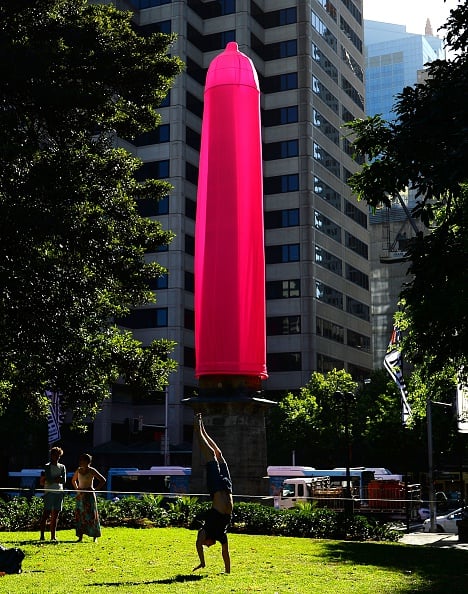
458551166 OPINION: Im not sorry that you might have to talk to your kids about condoms today.

It came almost as quickly as it was erected.

giant pink condom was lowered onto an obelisk in Sydney on Friday to raise awareness of HIV/AIDS. Almost immediately,  a cry  of “won’t somebody please think of the children”, soared into the public conversation.

Agitator Wendy Francis led the charge arguing the condom forced conversations about sex onto children at too early an age:

“There is a time and place for talking to children, and an age-appropriate time for parents to talk to children about condoms.

“Parents do not want to be forced into a situation where they have to explain something that’s not relevant.”

Like the famous giant butt-plug statue in Paris, the condom has raised the eyes of many in our communities, who are worried about the impact public conversations about sex have on our community, and in particular our children.

As they do, we have to ask, what are they so worried about?

You can read the full article at Mamamia.com.au